Broccoli Puree for Baby: The First-Food Recipe Most Moms Overlook
Banana, Sweet potato, Avocado, these are the first foods almost every new mom reaches for. Broccoli? It usually gets skipped either because moms assume babies will reject it, or because no one told them it is actually one of the most nutrient-rich first vegetables available.
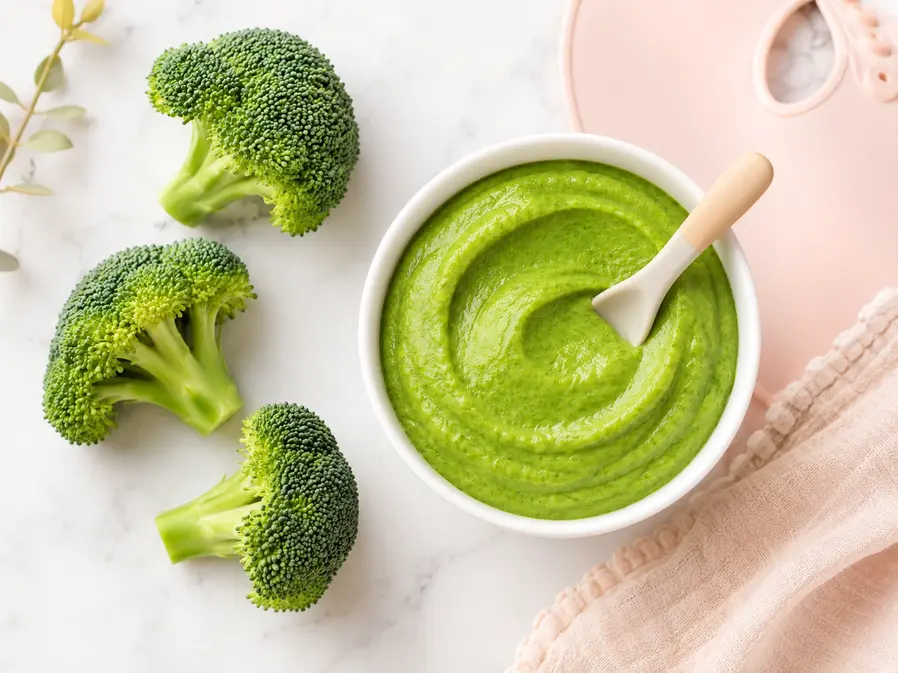
This complete guide to broccoli puree for baby covers exactly why this green vegetable deserves a spot in your baby’s first foods rotation, when to introduce it, how to prepare it properly, and what to do if your baby pushes the spoon away the first time.
When Can Babies Have Broccoli Puree?
According to the American Academy of Pediatrics (AAP), solid foods including vegetable purees can be introduced around 6 months of age, once a baby shows clear signs of readiness. Broccoli, when cooked until completely soft and pureed smooth, is appropriate from this age.
Just starting solids? See our First Foods for Baby at 6 Months guide for a simple place to begin.
Readiness signs (AAP guidelines):
- Baby sits with minimal support and has steady head control
- Baby shows interest in food watching you eat, reaching toward food
- Baby swallows food instead of immediately pushing it back out with the tongue
Why broccoli is often delayed unnecessarily: Some sources suggest waiting on broccoli because of its stronger flavor or gas-causing properties. However, according to pediatric dietitians and platforms like Solid Starts and Yummy Toddler Food, broccoli is safe from 6 months when cooked soft.
The mild gas it may cause is temporary and not harmful. Introducing bitter green vegetables early before 8 to 10 months is actually one of the strategies shown to reduce vegetable refusal later in childhood.
Why Broccoli Puree for Baby Is Worth Making
Most first-food lists are dominated by sweet fruits and starchy vegetables. Broccoli offers something different: a genuinely impressive nutrient profile that few other Stage 1 foods can match.
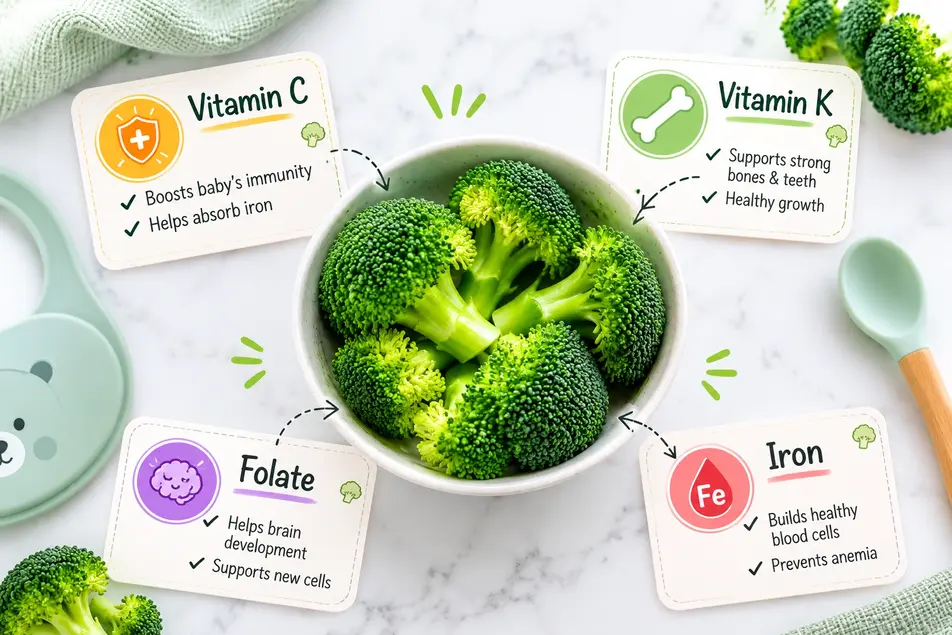
According to USDA FoodData Central (raw broccoli, Food ID #170379), per 100 grams:
| Nutrient | Amount | Why It Matters for Baby |
| Vitamin C | 89.2 mg | Supports immune function; boosts iron absorption |
| Vitamin K | 101.6 mcg | Essential for healthy blood clotting and bone development |
| Folate (B9) | 63 mcg | Supports healthy cell growth and brain development |
| Potassium | 316 mg | Supports heart and muscle function |
| Fiber | 2.6 g | Supports digestive health |
| Calcium | 47 mg | Important for developing bones and teeth |
| Iron | 0.73 mg | Contributes to healthy red blood cell production |
| Calories | 34 kcal | Low calorie, nutrient dense ideal for small tummies |
Broccoli contains more vitamin C per 100 grams than a medium orange. It is also one of the few vegetables that provides meaningful amounts of both vitamin K and folate two nutrients critical in the first year of life.
How to Make Broccoli Puree for Baby (Step-by-Step)
This recipe makes approximately 4 to 6 servings. Total time: under 15 minutes.
What you need:
- 1 medium head of fresh broccoli (or 2 cups of florets)
- Water for steaming
- Breast milk, formula, or reserved cooking water for thinning
Equipment:
- Steamer basket or saucepan
- Blender, food processor, or immersion blender
- Fine mesh sieve (optional, for very smooth texture)
- Ice cube tray for freezing
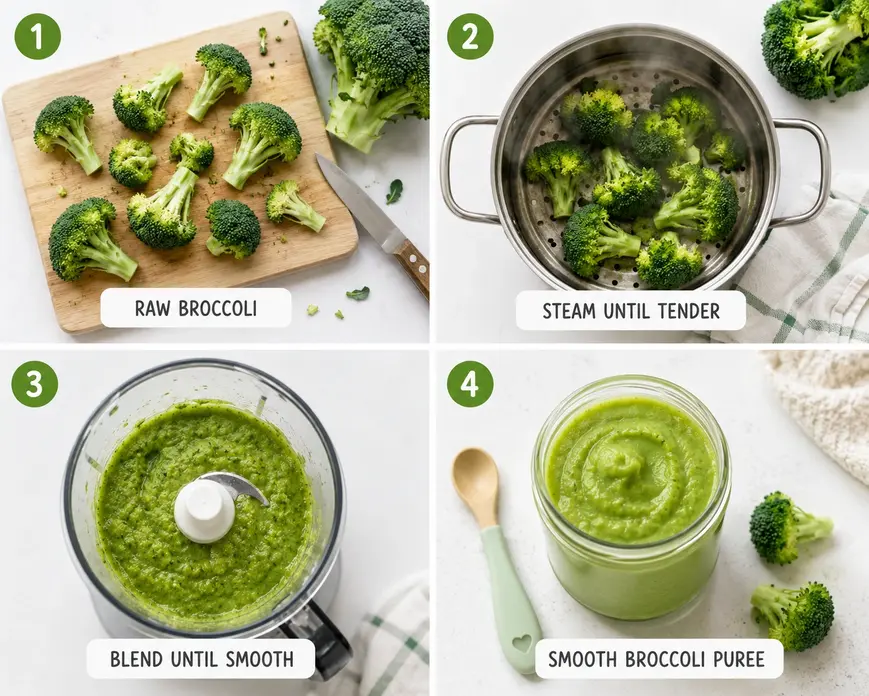
Step 1: Prepare the Broccoli
Wash the broccoli thoroughly under cold running water. Cut off the florets close to the stem. For broccoli puree for baby, florets only they blend smoother than the thick stem. If you want to use the stem, peel it and chop it small; it softens at the same rate as florets when steamed.
Step 2: Steam Until Completely Soft
Place the florets in a steamer basket over 1 to 2 inches of boiling water. Cover and steam for 8 to 10 minutes until the broccoli is completely soft it should pierce easily with a fork and offer no resistance at all. Do not skip this step or rush it. Undercooked broccoli blends poorly and creates a grainy, stringy texture babies find difficult to swallow.
Why steam instead of boil?
Boiling broccoli in water causes significant loss of water-soluble nutrients, especially vitamin C. Per research referenced by nutrition sources, boiling can reduce vitamin C content by up to 33%. Steaming preserves far more of the nutritional value. Save the water from steaming, it contains some dissolved nutrients and works perfectly for thinning the puree.
Step 3: Blend
Transfer the steamed florets to a blender or food processor. Add 2 to 3 tablespoons of the reserved steaming water, breast milk, or formula. Blend on high for 60 to 90 seconds until completely smooth.
Texture guide by age:
- 6 months: Very smooth and runny add more liquid until it flows easily off a spoon
- 7–8 months: Slightly thicker a smooth puree that holds its shape on a spoon
- 9–10 months: Can have very soft small lumps begin transitioning to mashed rather than blended
Step 4: Strain (Optional, for 6 Month Olds)
For younger babies just starting solids, pour the blended puree through a fine mesh sieve and press it through with a spoon. This removes any remaining fibrous bits and creates a perfectly silky texture. This step is optional for babies 7 to 8 months and older.
Step 5: Serve or Store
Serve immediately at room temperature or slightly warm. Never serve hot always test temperature on your wrist first.
How Much Broccoli Puree Should Baby Eat?
New eaters eat very small amounts. That is completely normal. At this stage, the goal is exposure and exploration not nutrition replacement. Your baby still gets the majority of their nutrition from breast milk or formula until 12 months.
| Baby’s Age | Portion Per Meal | Meals Per Day |
| 6 months | 1–2 teaspoons | Once daily |
| 7–8 months | 2–4 tablespoons | 1–2 times daily |
| 9–10 months | 4–6 tablespoons | 2–3 times daily |
Start with just one or two teaspoons. Increase gradually over several weeks as your baby shows interest and tolerance.
Best Broccoli Puree Combinations for Baby
Once your baby has tried plain broccoli puree for baby and tolerates it well, these combinations are the next step. Always introduce each new ingredient separately first.
For a naturally sweeter pairing, try our Apple Puree for Baby recipe.
| Combination | Best Age | Why It Works |
| Broccoli + Sweet Potato | 6 months | Sweet potato’s natural sweetness balances broccoli’s bitterness |
| Broccoli + Apple | 6–7 months | Apple’s mild sweetness softens the green flavor significantly |
| Broccoli + Pear | 6–7 months | Pear is one of the gentlest fruits great for sensitive tummies |
| Broccoli + Pea | 7 months | Doubles the green vegetable nutrition; similar mild flavor |
| Broccoli + Potato | 7–8 months | Potato creates a creamier, thicker texture babies love |
| Broccoli + Cheddar | 9–10 months | Classic combination; cheese adds fat and familiar flavor |
Storage and Freezing Guide
One of the best things about broccoli puree for baby is how well it stores making batch cooking genuinely worthwhile.
| Storage Method | Duration | Best Practice |
| Refrigerator | Up to 3 days | Airtight glass container only |
| Freezer | Up to 2 months | Freeze in ice cube trays first, then transfer to labeled freezer bags |
| Thawing | Overnight in fridge or warm water bath | Never microwave creates hot spots that can burn baby’s mouth |
| Reheating | Gentle warming in a bowl of warm water | Stir well and test temperature before serving |
One ice cube of puree equals approximately 1 ounce the right single serving for a new eater. Label every bag with the name and freeze date.
Comparison Table: Broccoli Puree vs. Other Common First Vegetable Purees
| Puree | Vitamin C | Vitamin K | Folate | Fiber | Flavor | Gas Risk |
| Broccoli puree for baby | ★★★★★ | ★★★★★ | ★★★★ | ★★★★ | Mild bitter | Low–moderate |
| Sweet Potato | ★★ | ★★ | ★★ | ★★★ | Sweet | Very low |
| Pea | ★★★ | ★★★ | ★★★★ | ★★★★ | Mild sweet | Low |
| Carrot | ★★ | ★ | ★★ | ★★★ | Sweet | Very low |
| Pumpkin | ★★ | ★ | ★ | ★★ | Mild sweet | Very low |
| Spinach | ★★★ | ★★★★★ | ★★★★★ | ★★ | Stronger bitter | Very low |
Source: USDA FoodData Central. Star ratings represent relative nutrient density per 100g of cooked puree.
Conclusion:
Broccoli gets overlooked as a first food because it is green, slightly bitter, and requires a little more patience than banana or sweet potato. But broccoli puree for baby is one of the most nutritionally complete vegetables you can offer in the first year with genuine amounts of vitamin C, vitamin K, folate, and fiber in every small spoonful.
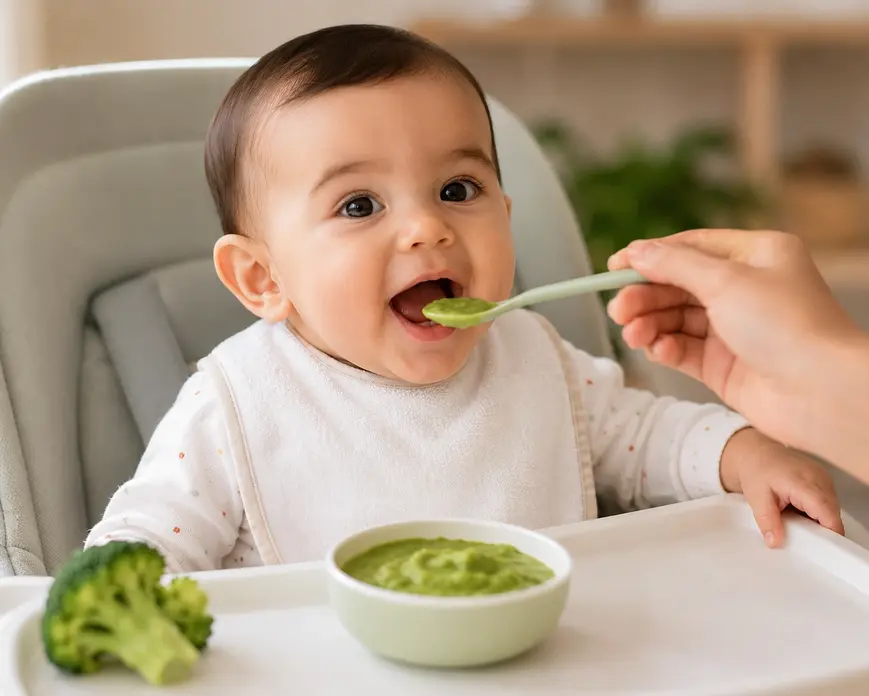
Make it smooth, steam it properly, pair it with something familiar if needed, and offer it repeatedly without pressure. The moms who stick with broccoli consistently find that their babies accept it, it just takes a little more time than the sweeter options. That patience is worth it.
Disclaimer:
This article is for general informational purposes only and is not a substitute for professional medical or nutritional advice. All nutritional data is sourced from USDA FoodData Central (Food ID #170379). Age guidelines for solid food introduction are based on AAP and WHO recommendations. Always consult your pediatrician before introducing solid foods, especially if your baby has known allergies, reflux, digestive issues, or other health concerns.
Conclusion
Building a baby registry doesn’t need to mean buying every product marketed as essential most baby items you don’t need are simply solving rare problems at a real cost in money and space. A shorter, more intentional list usually serves a new family better than a longer one. Before adding anything else to your cart, ask whether it solves something that happens often, or something that just sounds nice in theory.
Want more variety? Explore our Baby Food Combo Purees for more easy 6–12 month pairings.
Disclaimer:
This list reflects common parent experiences and general pediatric safety guidance, not a substitute for advice from your own pediatrician. What counts among baby items you don’t need can vary by family circumstance, so use your own judgment alongside professional guidance for anything safety-related.
FAQ’s
Q1: Can babies eat broccoli at 6 months?
Yes, According to the AAP and multiple pediatric dietitian sources including Solid Starts and Yummy Toddler Food, broccoli is safe for babies from 6 months when it is cooked until completely soft and pureed to a smooth consistency. Raw broccoli is never appropriate for babies it must always be steamed or boiled soft first. Some sources recommend waiting until 7 to 8 months because of broccoli’s slight gas-causing effect, but this is a matter of preference, not safety. Always check with your pediatrician before starting solids.
Q2: Does broccoli cause gas in babies?
Broccoli, like other cruciferous vegetables (cauliflower, cabbage, Brussels sprouts), contains compounds that can cause mild gas in some babies. This is temporary and not harmful. If your baby seems uncomfortable after eating broccoli, reduce the portion size and reintroduce slowly. Many babies have no gas reaction at all. Cooking broccoli well before pureeing reduces its gas-causing effect compared to raw broccoli.
Q3: Should I steam or boil broccoli for baby puree?
Steaming is significantly better. Boiling broccoli in water causes leaching of water-soluble vitamins particularly vitamin C into the cooking water, which is then discarded. Steaming preserves more nutrients because the broccoli is not in direct contact with the water. If you do boil, save and use the cooking water to thin the puree it contains some of the lost vitamins.
Q4: How do I get my baby to eat broccoli puree if they refuse it?
Refusal at the first introduction is extremely common and does not mean your baby dislikes broccoli permanently. Research consistently shows that babies may need 8 to 15 exposures to a new food before accepting it. Try mixing broccoli puree with sweet potato or apple puree (once those have been introduced separately). Always offer broccoli at the start of a meal when baby is hungry. Never force feed this creates negative associations with food. Keep offering every 3 to 5 days with a calm, neutral attitude.
Q5: Can I freeze broccoli puree for baby?
Yes, broccoli puree freezes very well. Pour the freshly made puree into a clean ice cube tray, cover with plastic wrap, and freeze for 4–6 hours until solid. Pop the cubes into a labeled freezer bag and store for up to 2 months. Thaw overnight in the refrigerator or place the sealed bag in a bowl of warm water. Never microwave baby food it creates uneven hot spots that can burn your baby’s mouth even when the outside feels cool. Stir well and always test temperature on your inner wrist before serving.