Watermelon Puree for Baby: The Hydrating Summer First Food at 6 Months
Here is a question. It is boiling hot outside, your baby just started solids, and you are staring at a giant watermelon on your kitchen counter wondering if your little one can actually have some. The answer is yes and making watermelon puree for baby takes about five minutes, zero cooking, and exactly one piece of equipment: a blender.
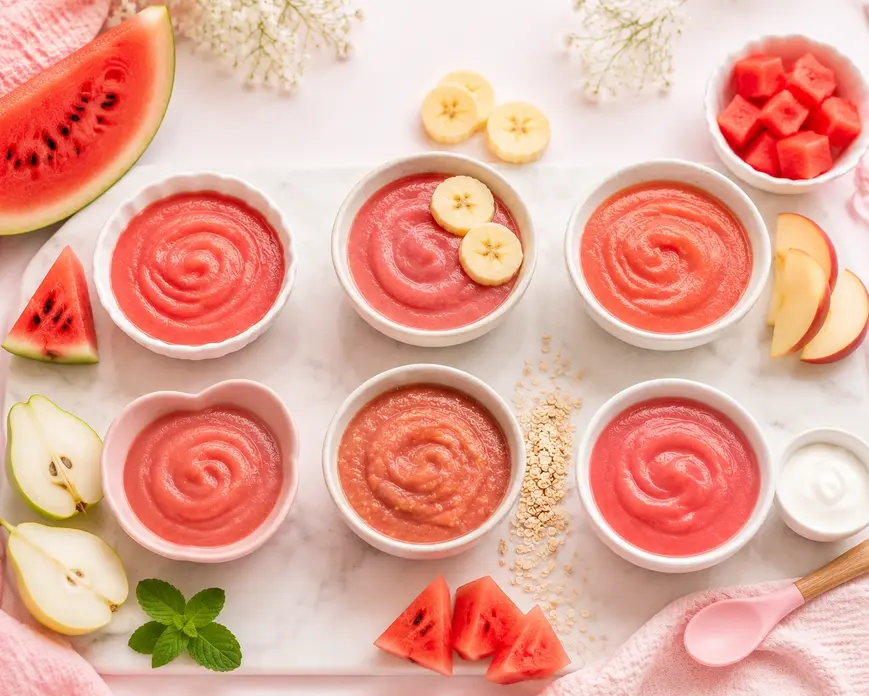
Watermelon is one of those first foods that gets skipped for no good reason. Parents reach for banana, sweet potato, and avocado all great choices but watermelon just sits there in summer, mostly ignored as baby food. That changes today.
This guide covers everything: when it is safe, how to make it, how to store it, and what to do when your baby looks at the spoon like you have offered them something suspicious.
Before offering watermelon puree, make sure your little one is showing the right signs and explore these first foods for baby at 6 months.
Is Watermelon Safe for a 6 Month-Old?
Yes, totally safe as long as you prepare it correctly.
Around 6 months is when most babies start exploring solid foods for the first time. Watermelon flesh is naturally soft, smooth when blended, and very easy for new eaters to handle. It does not need cooking. It does not have a strong or bitter taste that babies reject. And because it is mostly water, it is incredibly gentle on tiny tummies.
The two things that matter most with watermelon are simple: remove every black seed before blending, and use only the red flesh not the rind.
How do you know your baby is ready for solids?
- They can sit with a little support and hold their head steady
- They watch you eat and seem genuinely curious about food
- When you put a spoon near their mouth, they open up instead of turning away
- Food stays in their mouth when they swallow instead of being pushed straight back out by their tongue
If your baby is showing these signs around 6 months, they are ready to explore. Watermelon puree is a wonderful place to start especially in summer.
Why Watermelon Deserves a Spot in Your Baby’s First Foods
Let’s be real watermelon looks like a treat. It is sweet, it is bright red, it is juicy. But it is also doing some genuinely impressive things nutritionally for your baby.
It Keeps Baby Hydrated in the Heat
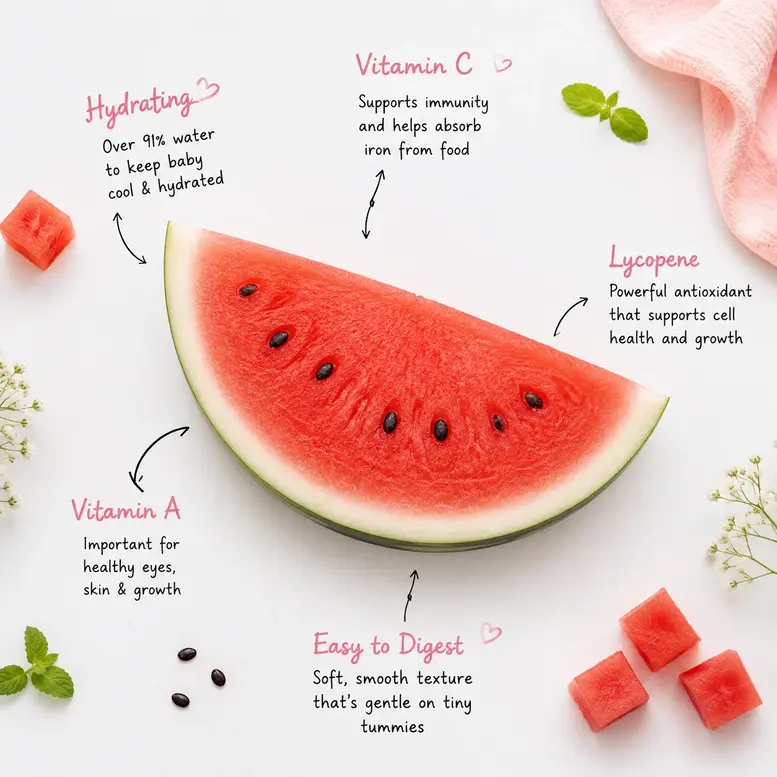
Watermelon is made up of more than 91% water. That is not a food fact people usually stop to think about, but it is remarkable. In summer, when the weather is hot and babies can get dehydrated faster than we realize, feeding your little one something that is almost entirely water but also sweet and enjoyable is a real advantage.
This is not a replacement for breast milk or formula, which are still your baby’s main source of everything until 12 months. But as a solid food addition, watermelon is one of the most hydrating things you can offer.
It Is Packed With Good Things
One small serving of watermelon gives your baby:
- Vitamin C — supports the immune system and helps the body absorb iron from other foods
- Vitamin A — important for healthy eye development and skin
- Potassium — supports healthy heart function and muscles
- Lycopene — the antioxidant that gives watermelon its red color. Watermelon actually has more lycopene than any other fresh fruit. It is a powerful compound that protects cells, and babies get it in every spoonful
And it has very low fiber which sounds like a bad thing, but for a new eater with a brand-new digestive system, it actually means watermelon is one of the gentlest fruits you can offer. No gas. No bloating. Just easy, smooth digestion.
It Needs Zero Cooking
On a hot summer day with a baby on your hip, the idea of steaming or roasting something before blending it feels exhausting. Watermelon needs none of that. You cut it, you deseed it, you blend it. Done. That alone makes it worth keeping in your rotation.
How to Make Watermelon Puree for Baby?
- Makes: About 6 to 8 small servings
- Time: 5 minutes
- What you need: A knife, a cutting board, a blender, and an optional fine mesh sieve for thicker texture
Step 1. Wash the Outside First
Before you cut anything, wash the outside of the watermelon with water and a clean cloth. This sounds unnecessary since you are not eating the rind but bacteria from the outside surface can travel onto the flesh as the knife passes through. A quick wash takes ten seconds and matters.
Step 2. Cut, Deseed, and Chunk
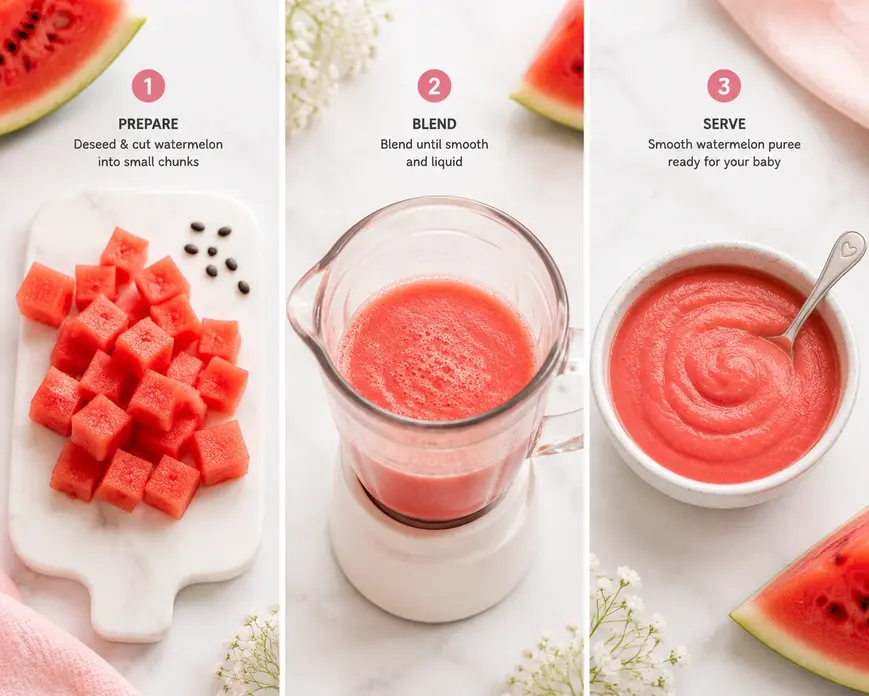
Cut a section of watermelon. Remove the green rind completely no rind goes into the puree. Cut the red flesh into rough chunks. Go through the pieces and remove every visible black seed. White immature seeds are soft and safe; black seeds are not.
Step 3. Blend
Drop the chunks into your blender. Blend on high for about 20 to 30 seconds.
That is genuinely all it takes. Watermelon does not fight the blender. It turns into a smooth, bright pink liquid almost immediately. Do not add water the fruit already has more than enough.
Is the texture right?
The puree will be quite thin and runny more like a thick juice than a classic puree. This is completely normal and fine for babies. If it feels too watery for your little one, see the thickening tips below.
Step 4. Strain (Optional but Helpful for Younger Babies)
Pour the blended puree through a fine mesh sieve and let it sit for two or three minutes. Press the remaining pulp gently with the back of a spoon. What drains away is mostly water. What stays in the sieve is a slightly thicker, spoon able puree much easier to feed with a baby spoon.
This step is optional. Many moms skip it entirely and just serve the thinner version directly.
Step 5. Serve or Store
Serve it at room temperature or slightly cool from the fridge. Always test it against your inner wrist first it should feel neutral, not cold or hot.
One important thing: Watermelon goes off faster than almost any other fruit once blended. Do not leave it sitting out for more than an hour. Bacteria love the warm, sugary liquid. Make it fresh, serve it, and refrigerate or freeze whatever is left immediately.
If your baby enjoys this refreshing fruit puree, try apple puree for baby next for another naturally sweet and gentle first food
How to Serve Watermelon to Baby by Age
Every age needs a slightly different approach not because watermelon becomes more or less safe, but because your baby’s abilities change quickly in the first year.
| Baby’s Age | Best Way to Serve |
| 6–7 months | Smooth blended puree by spoon. This is the easiest and safest starting point. |
| 6–7 months (baby-led weaning) | Thick rectangular strips of flesh with a small section of rind left on as a natural grip handle. The rind stops baby from shoving the whole piece in their mouth. Remove before they try to chew the rind itself. |
| 8–9 months | Small soft cubes, or puree mixed with banana or yogurt for a thicker consistency. Baby is starting to use their fingers. |
| 10–12 months | Small flat pieces or strips. Never serve round ball-shaped pieces flat and long is always safer for little ones still learning to chew. |
Watermelon Puree Is Too Runny — How to Thicken It
This is the most common thing moms notice the first time they make this. The puree slides off the spoon and ends up more on the bib than in the mouth. Here are three easy fixes:
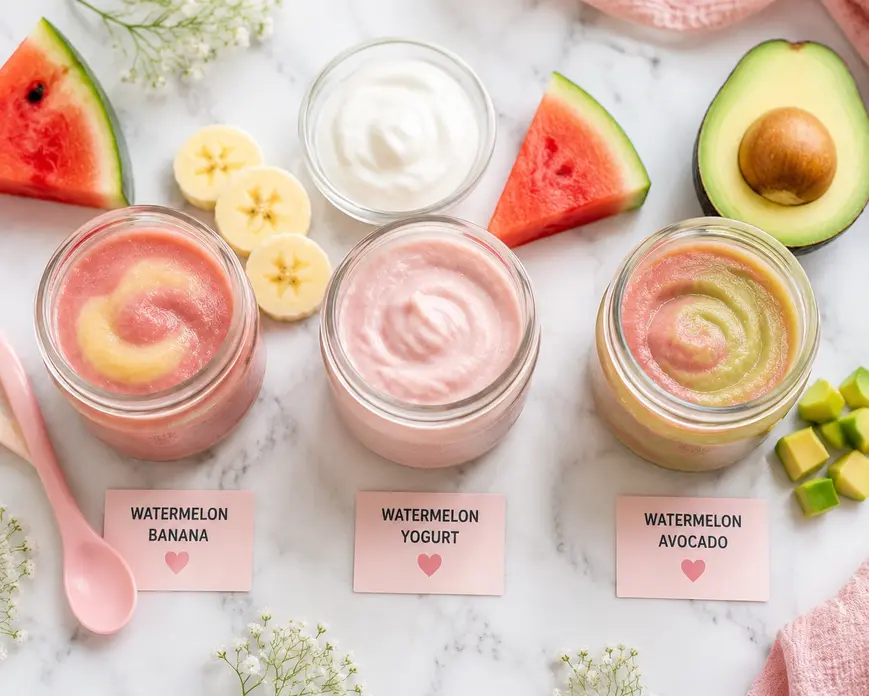
1. Add half a ripe banana before blending
The simplest solution. Banana thickens any puree instantly and the sweetness pairs perfectly with watermelon. Blend both together from the start. Safe from 6 months — introduce banana separately first if your baby has not tried it yet.
2. Stir it into plain full-fat yogurt
Take the strained puree and spoon it into plain whole milk yogurt. Stir together. The yogurt provides protein and calcium, and the watermelon sweetens it naturally without any added sugar. This makes a lovely pink, creamy Stage 1–2 combination. Yogurt is fine to offer in food from 6 months.
3. Mix with avocado
This sounds odd but works beautifully. Mash half a ripe avocado and blend it with watermelon chunks. The result is a thick, creamy, pastel pink puree that babies usually love. Avocado adds healthy fats that support brain development. Safe from 6 months.
How to Store Watermelon Puree
Watermelon puree has the shortest storage life of almost any baby food — and it is important to know this before you make a big batch.
| Storage | How Long | What to Remember |
| Fridge | 24 hours only | Airtight container. The liquid separates — give it a quick stir before serving. |
| Freezer | Up to 1 month | Freeze in ice cube trays right after making. Once frozen, pop cubes into a labeled bag. |
| Popsicle molds | Up to 1 month | Pour into small popsicle molds and freeze. A cooling, teething-friendly summer treat from 6 months. |
| Room temperature | 1 hour maximum | After that, throw it away. Do not refrigerate what has been left out. |
Freezer trick that moms love: Pour fresh watermelon puree straight into a silicone ice cube tray. Each cube is roughly one small serving. On a hot afternoon when baby is fussy and teething, pop a cube into a mesh feeder it is cooling, sweet, and soothing all at once.
Comparison Table: Watermelon Puree vs. Other Summer First Fruits
| Watermelon Puree for Baby | Mango Puree | Peach Puree | Banana Puree | |
| Cooking needed | No | No (if very ripe) | Light steaming | No |
| Water content | Highest — over 91% | Around 83% | Around 89% | Around 75% |
| How sweet is it? | Very sweet naturally | Very sweet | Sweet | Very sweet |
| Vitamin C | Good amount | High | Moderate | Moderate |
| Lycopene (antioxidant) | Highest of all fresh fruits | None | None | None |
| Fiber | Very low — easiest to digest | Moderate | Low | Moderate |
| Puree texture | Thin — needs thickening | Thick naturally | Medium | Thick naturally |
| Fridge life | 24 hours | 3 days | 3 days | 24 hours |
| Best thing about it | Hydration + watermelon puree for baby lycopene content | Vitamin A boost | Gentle on tummies | Quick and filling |
Disclaimer
This guide is written for general information only and is not medical advice. Every baby is different, and what works for one little one may not suit another. Always talk to your own doctor or health visitor before starting solids or introducing new foods especially if your baby has any health conditions, reflux, or known food sensitivities. Never give watermelon juice to babies under 12 months whole fruit and purees are always the better choice. Juice concentrates sugar without the fiber and is not recommended for babies.
Conclusion
If you have been walking past watermelons at the market all summer without thinking about them as baby food, now you know watermelon puree for baby might be the easiest thing you ever make. No cooking. No special prep. Just a ripe melon, a blender, and five minutes. It keeps your baby hydrated on hot days, it is genuinely nutritious, and most babies take to the sweetness right away. Make a batch, freeze some cubes, and enjoy one of those rare moments where feeding your baby feels simple and actually a little fun.
Want to add more variety to your baby’s menu? Try this smooth carrot puree for baby as an easy vegetable option.
FAQ’s
Q1: Can I give watermelon puree to my 6-month-old baby?
Yes, you can. Watermelon flesh is naturally soft and blends into a smooth puree that is very easy for a new eater to handle. The two things that matter most are removing all black seeds before blending they are a choking risk and using only the red flesh, not the rind. Start with just a teaspoon or two on the first day and watch for any unusual reaction over the next couple of days before offering more.
Q2: Do I need to cook watermelon before making it into baby food?
No, and this is one of the best things about it. A ripe watermelon is soft enough to blend completely raw. Cooking actually reduces some of the vitamin C content, so serving it fresh is genuinely better. Just cut, deseed, blend, and serve. No steaming, no boiling, no oven required.
Q3: Why is my watermelon puree so watery? How do I make it thicker?
Because watermelon is over 91% water, the puree is naturally very thin more like a thick pink juice. The easiest fix is blending it with half a ripe banana, which thickens it instantly. You can also stir the strained puree into plain full-fat yogurt, or mix it with mashed avocado. All of these combinations are safe from 6 months, as long as your baby has already tried each ingredient on its own first.
Q4: How long does homemade watermelon puree last?
Only 24 hours in the fridge. Watermelon’s high water and natural sugar content means it spoils faster than most other baby food purees. If you make more than you need for one sitting, pour the rest into an ice cube tray and freeze it straight away. Frozen watermelon puree keeps well for up to a month. Thaw individual cubes overnight in the fridge and serve the next day.
Q5: Is watermelon a choking hazard for babies?
When prepared correctly, watermelon is one of the lower-risk fruits because the flesh is so soft. The key is preparation. As a smooth puree, the risk is minimal. For baby-led weaning at 6–7 months, serve it as thick finger-length strips with a small bit of rind left on as a grip handle the rind naturally stops baby from pushing too much flesh into their mouth at once. Always avoid round or ball-shaped pieces of any food, as these are harder for babies to manage safely. And always stay right there with your baby during meals.