
My Baby Refused All Food Untill I Tried This One Simple Trick
If your baby won’t eat and every meal feels like a battle, you’re not alone. For weeks, my baby refused almost every food I offered. The more I pushed, the worse things became. What finally helped wasn’t a new recipe or feeding gadget. It was a simple change in how I approached mealtime.

In this guide, you’ll learn the most common reasons for food refusal. The feeding approach that turned things around for us, and the signs that mean it’s time to call your pediatrician.
Confused for baby food? Try our these baby foods easy to made with baby love.
Why You Can Trust This Guide
- Written from a real, lived feeding struggle, not a theory pulled from a textbook
- Cross-checked against guidance from registered pediatric dietitians and established feeding-therapy resources
- Includes a clear, separate list of warning signs that call for a doctor, not just a parenting tweak
- No paid placements or brand sponsorships shaping which advice made the list
- Updated periodically to stay aligned with current general feeding guidance
Why Your Baby Won’t Eat: The Real Reasons Behind Food Refusal
Before changing anything about how we fed our daughter, it made a real difference to understand why a baby won’t eat in the first place. Refusal is rarely about stubbornness. It is almost always a signal, and learning to read that signal, instead of fighting it, changed how every meal in our house went. The signal is usually one of these.

1. Teething and Illness:
Sore gums, a stuffy nose, or a scratchy throat can make chewing and swallowing genuinely uncomfortable. A baby who was eating well last week and suddenly stops could simply be fighting off a cold or cutting a new tooth. This kind of refusal tends to pass once the discomfort does, usually within a few days.
2. Overtiredness:
A baby who skipped a nap or stayed up late is not primed to sit and eat. Slow blinks, a glazed expression, and general fussiness in the high chair are often signs of tiredness rather than dislike of the food itself. Offering the same meal again after a proper rest often goes far better than pushing through in the moment.
3. Not Developmentally Ready Yet
Pediatric guidance generally points to around six months as the typical window for starting solids, once a baby has steady head and neck control and shows real interest in food. A baby under that age who is not interested in solids is often simply not ready yet, and that is not a cause for alarm. Readiness shows up on its own timeline, not a calendar date.
4. Too Much Milk or Snacking Between Meals
A baby who is filling up on milk, juice, or frequent snacks between meals is often genuinely not hungry at the table. Spacing out feeds and snacks gives appetite room to build before the next meal, which sounds obvious but is easy to overlook during a busy day.
5. When It’s Something More
Occasionally, food refusal points to something beyond a normal phase, such as reflux, a swallowing difficulty, or a sensory sensitivity to certain textures. If refusal is constant rather than occasional, or comes with gagging, choking, or visible distress at every meal, it is worth raising with your pediatrician rather than waiting it out. A short conversation can rule out a bigger issue or connect you with a feeding therapist who specializes in exactly this.
The Trick That Changed Everything: Division of Responsibility
The single shift that turned our baby won’t eat phase around was something called the division of responsibility in feeding, a framework developed by registered dietitian Ellyn Satter and adopted widely by pediatric feeding specialists since. It sounds almost too simple, but it rebuilt mealtime from the ground up in our house.

What Division of Responsibility Actually Means
The idea splits mealtime into two clear roles. The parent decides what food is offered, when it is offered, and where it happens. The child decides whether to eat it at all, and how much. Once I stopped trying to control the “whether,” the standoffs at the table mostly disappeared.
How I Applied It At Home
In practice, this meant putting a simple, familiar food on the tray alongside one new food, then stepping back. No coaxing, no airplane spoons, no narrating every bite. Some meals she ate plenty. Some meals she touched nothing. Both outcomes were treated the same way: calmly, without comment.
Letting Baby Watch Us Eat
Pediatric feeding resources consistently point to one detail that is easy to overlook: babies learn to eat partly by watching. Pulling her high chair up to our table, rather than feeding her separately beforehand, gave her a chance to see chewing, pacing, and enjoyment modeled in real time.
Why Repeated Exposure Matters More Than Variety
One detail from pediatric nutrition guidance reframed everything for me: many children need to see a new food roughly six to seven times, and taste it ten to fifteen times, before genuinely accepting it. A single rejected bite is not a final verdict. It is one data point in a much longer process.
What I Stopped Doing
I stopped offering a backup snack the moment a meal was refused. I stopped negotiating dessert in exchange for vegetables. I stopped extending mealtime past twenty minutes to “get more in.” Every one of those habits, however well-meaning, had quietly taught her that refusing food led to something better showing up.
The Worry Every Parent Has About This Approach
The question that kept me up at night was simple: what if she just does not eat enough? Pediatric sources are consistent on this point: a healthy baby will not let themselves go truly hungry for long, and missing a meal here and there is not the same as long-term undereating. Growth happens in spurts rather than a perfectly even line, and a single skipped lunch rarely shows up on a growth chart weeks later. The reassurance that genuinely settled my nerves was this: my job was to keep showing up with food, calmly and consistently. Her job was to decide what to do with it.
Mistakes That Make It Worse When Your Baby Won’t Eat
Looking back, several habits that felt protective during our baby won’t eat phase were actually working against us, and most parents I have since talked to recognize at least two or three of these from their own kitchens.
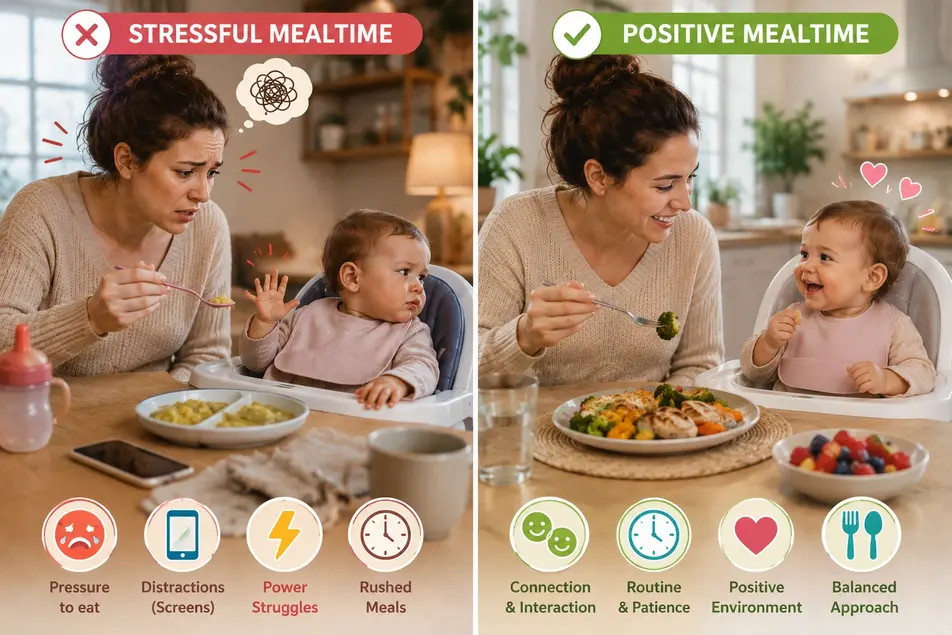
- Pressuring “just one more bite.” This usually buys a single extra bite at the cost of a much longer standoff.
- Swapping in a different food after a refusal. This quietly teaches a baby that holding out gets a better option.
- Feeding the baby separately from the rest of the family. Without anyone to copy, mealtime can feel more like a test than a shared moment.
- Stretching meals far past their natural length. Long, drawn-out meals tend to turn into battles rather than progress.
- Offering dessert, screens, or treats as a bargaining chip. This can make plain, everyday food feel like a punishment by comparison.
Quick Comparison: Old Approach vs Division of Responsibility
| Old Approach | Why It Backfired | Division of Responsibility (What Worked When Baby Won’t Eat) |
| Pressuring “one more bite” | Raised tension and increased refusal | Offer the food, then let the baby decide |
| Swapping food after refusal | Taught baby that refusal brings something better | Same meal stays on the table, no swap |
| Feeding baby separately | No one to model eating from | Baby eats with the family, every meal |
| Stretching mealtime longer | Turned meals into standoffs | Kept meals to about twenty minutes |
| Bribing with dessert or screens | Made plain food feel like punishment | Stayed calm and neutral, no bargaining |
A Simple Day of Pressure-Free Feeding
Structure made a bigger difference than any single food choice during our baby won’t eat phase. A predictable rhythm did more to rebuild her appetite than any clever recipe ever did. Here is roughly how a pressure-free day looked for us, offered as a general pattern rather than a fixed meal plan, since every baby’s nutritional needs and readiness for textures are different and worth checking with your pediatrician or a feeding specialist.

Morning:
Milk feed first, then a simple breakfast offered alongside the family’s meal, with no pressure to finish it.
Mid-morning:
A short window with only water available, no snacks, to let appetite build naturally before lunch.
Lunch:
A familiar food paired with one small portion of something new, served at the table with the rest of the family.
Afternoon:
A planned snack at a consistent time, rather than grazing throughout the day.
Dinner:
The same meal as the rest of the household whenever appropriate for her age and chewing ability, eaten together rather than separately.
Evening milk feed:
Offered after dinner rather than right before, so it does not blunt appetite at the table.
The exact foods mattered far less than the rhythm. A predictable, low-pressure structure gave her appetite room to show up on its own. Some days she ate three solid meals. Other days she barely touched lunch and made up for it at dinner. Both versions of that day were fine, and treating them as equally fine, rather than as a win or a failure, was part of what made the whole approach sustainable past the first rough week.
How Long Did It Actually Take to See Results?
How long does it take to see results? In our case, the first week felt slow, and sometimes even harder than before. By the second week, mealtime battles became less frequent. The biggest change came around the fourth week, when meals started feeling calm and routine again. Pediatric feeding experts note that changes in eating behavior often take several weeks of consistent, pressure-free feeding. Give the approach time before deciding whether it is working.
When to Call Your Pediatrician

Most cases of a baby refusing food are temporary and improve on their own. However, some situations require medical attention. Contact your pediatrician if you notice any of the following warning signs:
- Your baby is refusing liquids as well as solid food, not just specific foods
- You notice signs of dehydration, such as fewer wet diapers, a dry mouth, or a sunken soft spot
- The total refusal lasts more than a few days in a row
- Your baby seems unusually sleepy, limp, or hard to rouse
- There is vomiting, diarrhea, or visible pain when swallowing
- Your baby gags, chokes, or shows distress at nearly every single meal
- You notice little to no weight gain over several weeks, or weight loss
- Your baby shows little interest in or response to food, people, or surroundings at the table
Author Words:
If your baby won’t eat, try not to panic. Food refusal is a common phase that many babies and toddlers experience as they grow and develop. Focus on creating a calm, pressure-free mealtime environment, offer a variety of foods regularly, and allow your child to decide how much to eat. Progress often takes time and consistency rather than quick fixes. However, if your baby shows signs of dehydration, weight loss, illness, or prolonged food refusal, contact your pediatrician for guidance.
Disclaimer:
This baby won’t eat guide reflects personal experience and general feeding research drawn from pediatric registered dietitians and child-feeding resources. It is not medical advice and does not replace an exam from your child’s doctor. If your baby is refusing liquids as well as food, shows signs of dehydration, has lost weight, seems unusually tired or unresponsive, or the refusal lasts more than a few days, contact your pediatrician promptly, since these signs can point to a medical issue rather than ordinary food refusal.
FAQ’s
1. Why has my baby suddenly stopped eating solid food?
A sudden stop is often linked to teething, a minor illness, overtiredness, or a recent change in routine. It can also follow a stretch of pressure at the table, where a baby starts associating mealtime with stress. If liquids are still going down fine and your baby seems otherwise well, energetic, and interested in their surroundings, it is usually temporary and resolves within a week or two on its own.
2. What should I do if my baby refuses to eat anything?
Keep offering food at regular times without pressure, let your baby watch the rest of the family eat, and avoid swapping in a different food right after a refusal. Resist the urge to comment on what was or was not eaten, since even gentle attention to refusal can reinforce it. If the total refusal includes liquids, or lasts more than a few days, reach out to your pediatrician rather than waiting it out.
3. How long can a baby go without eating before I should worry?
Missing a single meal is rarely a concern, since appetite naturally varies day to day and across growth spurts. A pattern of barely eating for several days in a row, especially alongside fewer wet diapers or noticeable tiredness, is the point at which a check-in with your pediatrician makes sense, rather than a fixed number of hours or meals.
4. Is it normal for a baby to refuse food when teething?
Yes, this is extremely common. Sore, swollen gums can make chewing uncomfortable, and many babies temporarily prefer soft, cool foods or simply want extra milk feeds until the discomfort passes. This kind of refusal usually clears up within a few days of the tooth coming through.
5. When should I see a doctor about my baby not eating?
See your pediatrician if your baby is also refusing liquids, shows signs of dehydration, has lost weight, seems unusually lethargic, or the refusal continues for more than a few days. A doctor can rule out reflux, swallowing issues, or other causes that need a different kind of support than a feeding-approach change.