Baby Essentials Every New Mom Needs to Know First
Nobody warns you what happens when you walk into a baby store for the first time before your due date. One hour in, your basket is full, your budget is gone, and you still cannot tell which of the seventeen types of bottle nipples is the right one. The baby essentials that genuinely matter in those first weeks are a much shorter, simpler list than every retailer wants you to believe. This guide is that list built from what parents consistently report actually reaching for every single day, grounded in safety guidance, and honest about what can wait.
Why You Can Trust This Guide
- No sponsored brand recommendations this guide discusses categories, not paid partnerships
- All safety notes reference current AAP and general pediatric guidance, last reviewed June 2026
- Grounded in recurring patterns from real parent communities, not a single source
- Postpartum essentials for the mother included a category most guides overlook entirely
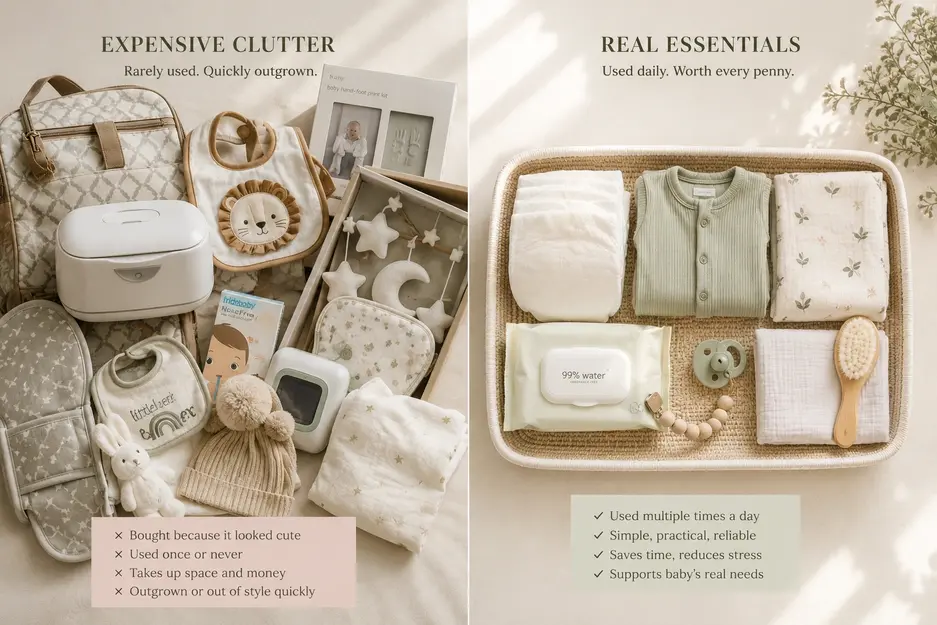
What Separates Real Baby Essentials From Expensive Clutter
Walk into any baby aisle with a fresh registry and the pressure to buy everything is real. Stores are designed to make optional products feel urgent. The result is that most first-time parents buy items they rarely or never reach for again a pattern reported consistently across parenting communities.
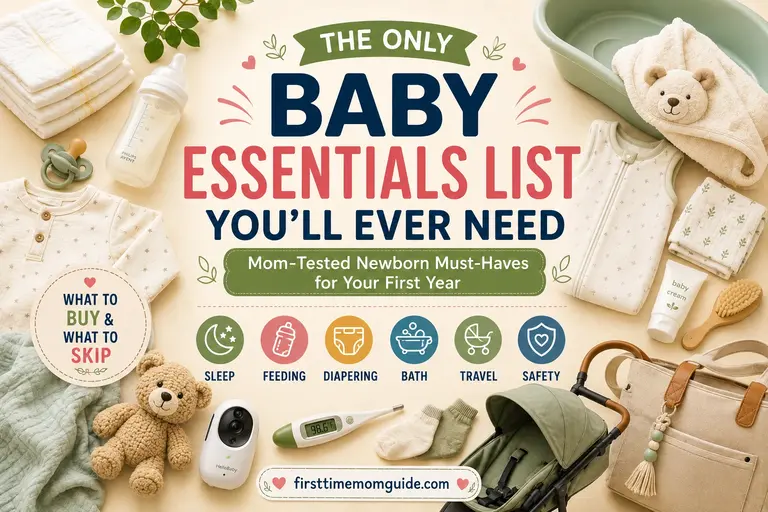
Looking for a quick checklist? Explore our Mom-Tested Baby Essentials List for an easy shopping guide.
The One Question That Filters Everything
Before adding anything to a registry or basket, ask one question: does this item do something that cannot be done without it, or just something more conveniently? A car seat does something no alternative can do. A wipe warmer adds warmth to a wipe. That single question, applied honestly, eliminates most of the marketing clutter before a single item gets picked up.
What Experienced Parents Tell First-Timers
The most consistent advice from parents across forums and communities is not about which brand to buy. It is about how much to buy. Get the minimum in the first weeks. Add items after the baby arrives, once you know what your specific baby responds to. A baby who settles in a swing makes it worthwhile. A baby who screams in one makes it an expensive doorstop. Waiting two weeks costs nothing.
The Four Things Every Newborn Genuinely Needs
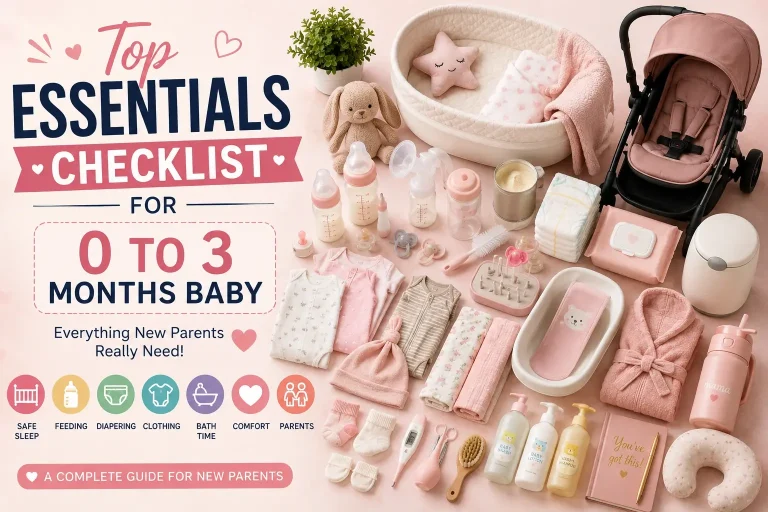
Everything on a baby essentials list falls into one of four categories:
- Warmth appropriate clothing, swaddles, and a sleep space at a safe temperature
- Food breast milk, formula, or a combination, with whatever equipment supports that choice
- Sleep a safe, firm, flat surface with nothing else inside it
- Comfort holding, skin-to-skin contact, a baby carrier, or a white noise machine
Anything outside these four categories is optional. That includes most of what fills a baby store.
Why the Baby Essentials List Gets Shorter With Every Child
Experienced parents consistently report that about half of what they bought for their first child went largely unused. First-time parents overbuy. Second and third-time parents underbuy and still have everything they need. The baby essentials list is shorter than any registry template suggests, and that pattern appears reliably enough to build a shopping plan around from the start.
The Complete Baby Essentials Guide: Category by Category
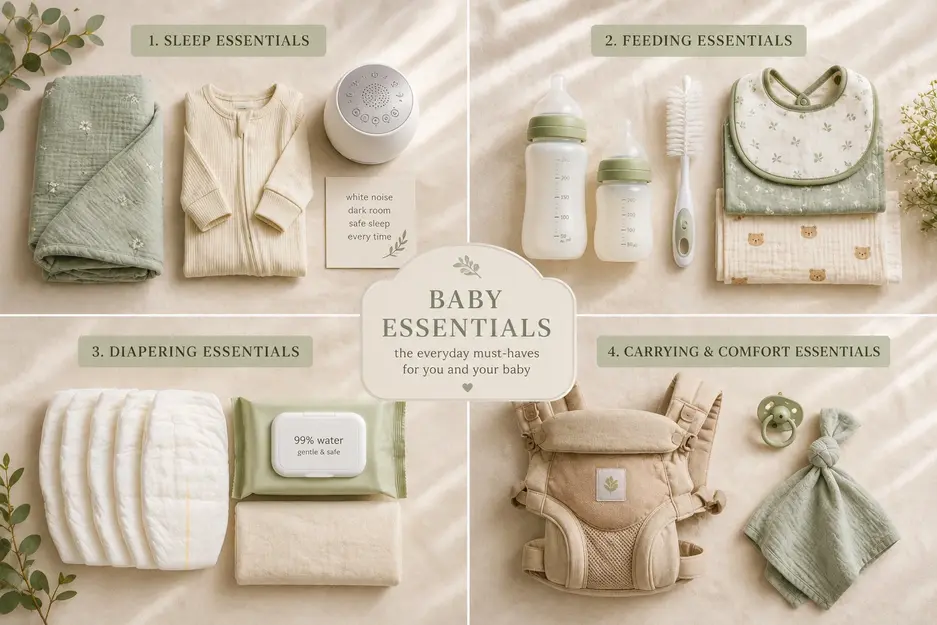
Sleep Essentials The Highest Priority Category
The items that get reached for most in the first three months are almost always sleep-related. Not because babies sleep well they often do not but because every minute of sleep, for both baby and parent, becomes precious almost immediately.
Safe sleep space:
: A firm, flat sleep surface inside a crib or bassinet that meets current safety standards is the single most important purchase on any baby essentials list. Current AAP guidance is clear: the sleep space should be completely bare no pillows, no bumpers, no loose blankets, no positioners. Crib bumpers have been illegal to manufacture or sell in the United States since 2022 under the Safe Sleep for Babies Act. No bumper set belongs in a modern nursery.
Swaddle blankets:
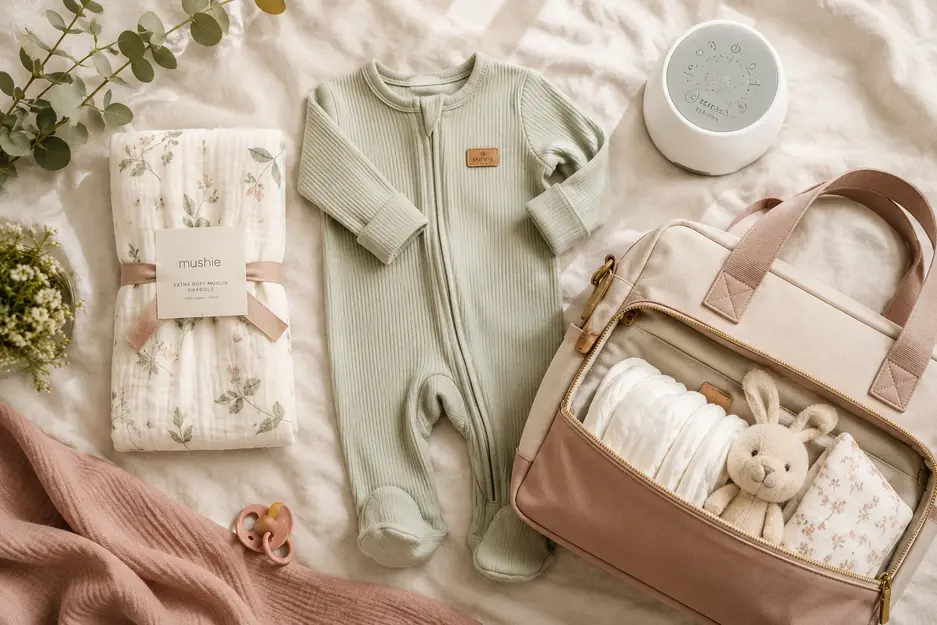
Three to four breathable muslin swaddle blankets do more for a restless newborn than almost any gadget on the market. Plain, unbranded muslin wraps in neutral colours wash better and double as a stroller cover, a burp cloth in a pinch, and a shade cloth outdoors. Skip the themed matching sets.
White noise machine:
A white noise machine is one of the few baby essentials that parents across communities consistently name as genuinely transformative. Newborns spent nine months listening to the constant sounds of the womb silence is not natural or soothing. A machine placed at a safe distance and volume provides consistent background sound that competes with household noise. Parents across multiple forums report it extending sleep stretches and settling fussy babies faster than most other approaches.
Sleep sacks:
Once a baby shows signs of rolling, a wearable sleep sack replaces the swaddle as the safe way to keep a baby warm without loose blankets in the crib. Buy one or two in the next size up before the swaddle stage ends.
What to skip:
Crib bumpers (unsafe, illegal in US since 2022), sleep positioners (unsafe per AAP guidance), elaborate nursery decor inside the crib, and baby monitors with more features than your situation actually warrants. A basic audio monitor covers most families’ needs.
Feeding Essentials: The Actual Minimum
Whether breastfeeding, formula feeding, or combining both, the core list for feeding is shorter than stores suggest.
Bottles and nipples:
Six to eight bottles are a practical starting quantity for formula-fed babies. For breastfeeding families who plan to introduce a bottle, two to four bottles initially are often enough. Avoid buying large quantities of one brand before knowing whether your baby accepts the nipple shape babies have strong preferences that cannot be predicted in advance.
Burp cloths:
Buy more than feels necessary. Ten to twelve plain muslin cloths are not excessive for the first few weeks. Parents consistently report running out during growth spurts, and running out at 3 a.m. is genuinely unpleasant.
Nursing essentials (for breastfeeding parents):
Nursing pads, nipple balm, and a supportive nursing bra are the genuine daily workhorses. A firm nursing pillow a curved pillow that props the baby at breast height is widely reported as one of the most valuable purchases for new breastfeeding mothers, particularly for the back support it provides during round-the-clock feeds.
Sterilizing equipment:
A steam sterilizer, microwave sterilizing bag, or cold water sterilizer all work. The method matters less than having a consistent routine.
What to skip:
Bottle warmers (warm tap water achieves the same result in the same time, with no counter space required), bottle sterilizing accessories beyond a basic brush, and specialty formula blenders.
Diapering Essentials: The Honest Quantities
Nappies across two sizes:
Stock one to two packs of newborn size and one pack of size 1. Some babies skip newborn size within the first ten days. Buying a large quantity of newborn size before knowing your baby’s birth weight is one of the most commonly reported nappy-related regrets.
Unscented wipes:
The wipe warmer is mentioned more often across Reddit and Quora as a waste of money than almost any other product. Babies adjust to room-temperature wipes within days. Unscented wipes in bulk are all that is needed.
A nappy cream:
A barrier cream for nappy rash protection belongs in every home from the first day. Have it before you need it.
Changing mat:
A firm, portable changing mat on a low dresser works as well as any dedicated changing table and takes up far less space. Many experienced parents actively recommend against a dedicated changing table.
Compact nappy bag:
A lightweight bag with two or three internal pockets covers every outing. The large, structured nappy bags that line store shelves are consistently reported as heavy, impractical one-handed, and far bigger than any outing requires.
Carrying and Comfort Essentials
Baby carrier:
A soft-structured baby carrier or ring sling is among the most consistently recommended baby essentials across every major parenting community. It frees both hands, keeps the baby close and calm, and is one of the few items that parents with very different parenting approaches all tend to agree on. A well-fitting carrier with a straight back, knee-to-knee thigh support, and the baby’s face visible at kissable distance follows current babywearing safety guidance.
Pacifiers:
Not strictly essential, but widely reported as genuinely calming for many babies. The AAP notes that pacifier practice during sleep is linked with a reduced risk of SIDS. If breastfeeding, introduce after feeding is established. Have two or three they get lost quickly.
Bouncer or swing:
Some babies settle instantly in a bouncer. Others never warm to one. The most honest approach is to borrow one from a friend before buying. Buying first is one of the most reported wasteful purchases when the specific baby turns out not to like it.
Health and First Aid Essentials
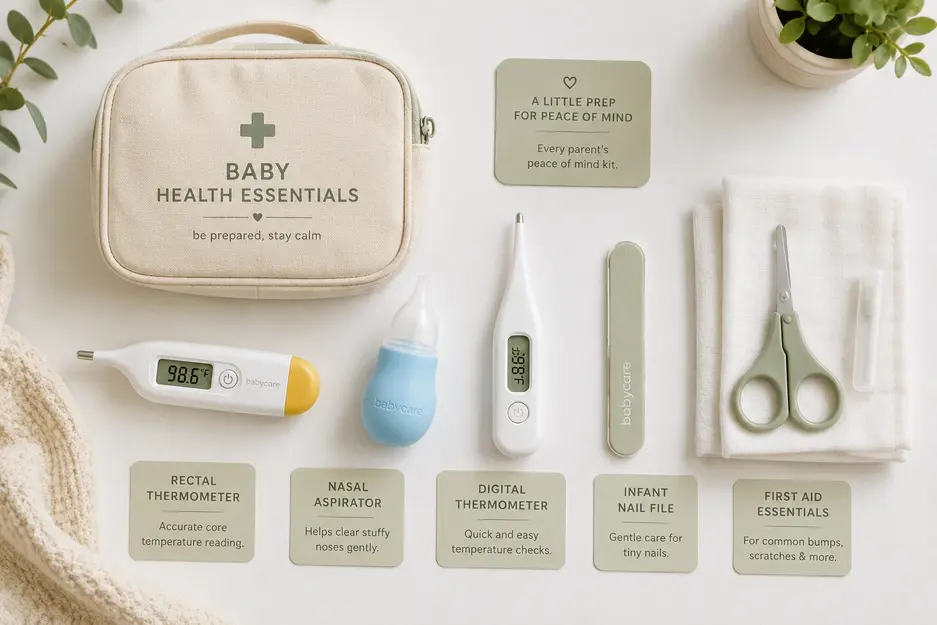
Rectal thermometer:
Non-negotiable. Pediatricians consistently emphasize that a fever in a newborn is a potential medical emergency, and rectal temperature is the most accurate reading for infants. Have it before the baby arrives.
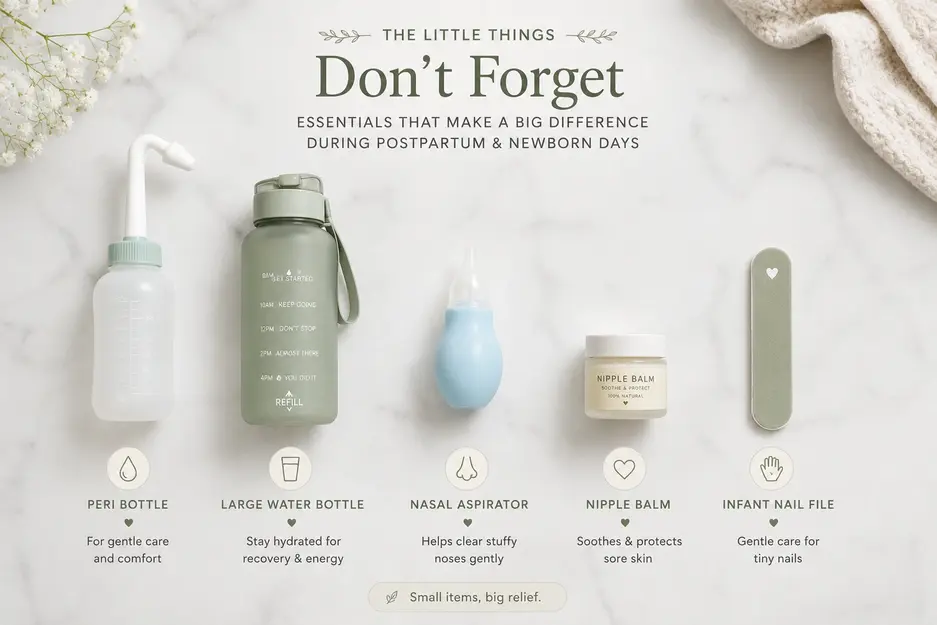
Nasal aspirator:
Newborns cannot blow their own nose. A nasal aspirator becomes one of the most reached-for items in the house during any period of congestion. Both bulb syringe and suction-based types are reported as effective.
Infant nail clippers or file:
Newborn nails grow faster than expected and are sharp enough to scratch the baby’s own face. Infant-specific clippers with rounded tips are safer than adult clippers on tiny fingers.
Basic first aid kit:
A digital thermometer backup, antiseptic wipes, rounded scissors, and infant paracetamol (age-appropriate dose confirmed with a pharmacist) cover the basics at home.
Postpartum Essentials for Mom: The Category Everyone Forgets
This is the section most baby essentials lists skip entirely. The mother’s recovery is as much a part of the first few weeks as the baby’s needs and arriving home from hospital without the supplies for it makes an already demanding period significantly harder.
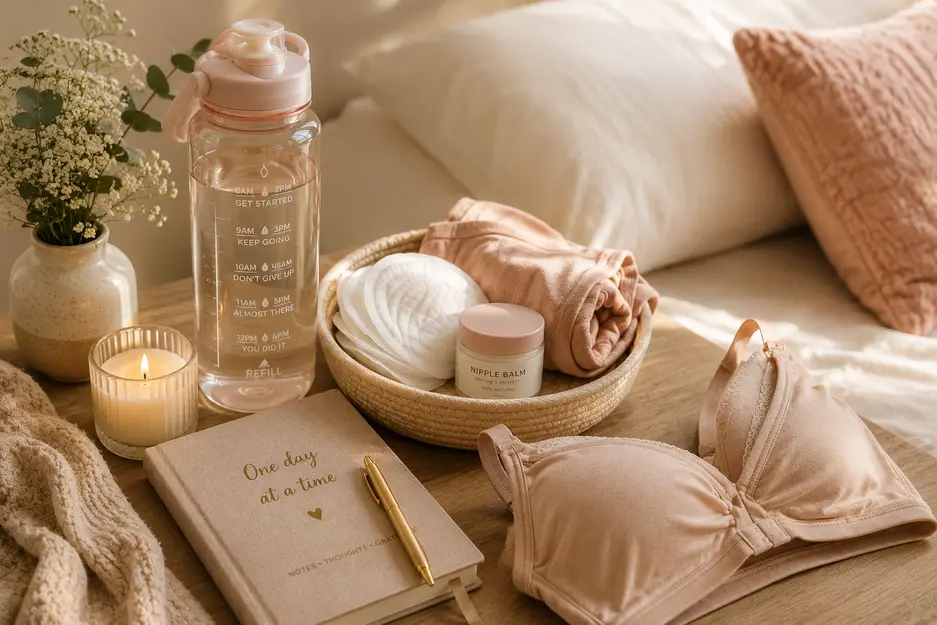
Postpartum pads:
After birth, postpartum bleeding called lochia commonly lasts up to six weeks. Standard period pads are not sufficient in the early days. Long, thick postpartum pads or disposable postpartum underwear are the honest requirement. Stock two weeks’ worth before the birth.
Peri bottle:
A small squeeze bottle filled with warm water makes toileting after a vaginal birth significantly more comfortable. Hospitals often provide one having a backup at home is practical.
Nipple care:
Nipple balm and nursing pads are functional from the first day for breastfeeding mothers. Soreness and leaking both begin earlier than most first-time mothers expect.
Comfortable nursing-friendly clothing:
Loose, soft, nursing-accessible tops and soft waistband bottoms are what actually get worn in the first two weeks. Prioritizing nursing-accessible openings over aesthetics is a shift most new mothers report making after the fact.
A large water bottle:
Breastfeeding increases thirst noticeably. A large water bottle within arm’s reach at every feeding station is one of the simplest and most consistently reported practical additions to a postpartum setup
The Baby Essentials Timeline: What to Buy and When
Not everything on a baby essentials list needs to be purchased before the birth. Spreading the buying across a timeline reduces overwhelm and prevents stocking up on items that turn out not to suit your baby.
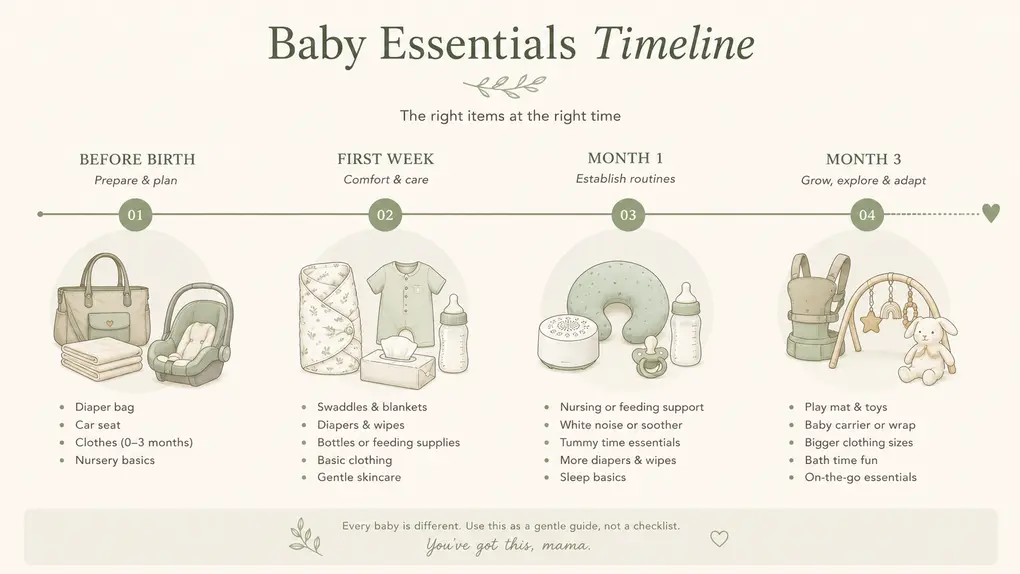
Before birth: (Essential to have ready)
Car seat, safe sleep space, nappies across two sizes, wipes, swaddle blankets, feeding equipment, postpartum recovery supplies for mom, rectal thermometer, nasal aspirator, and a basic first aid kit.
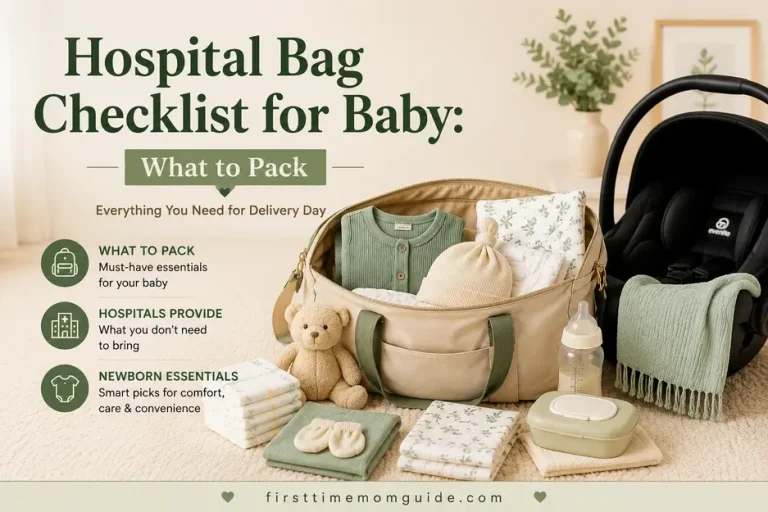
Packing for delivery? Don’t miss our complete Hospital Bag Checklist for Baby before heading to the hospital.
First week: (Add if needed)
More burp cloths (almost everyone needs more), white noise machine, nursing pillow, and any feeding-specific equipment that turns out to be necessary once breastfeeding or bottle feeding begins.
After two weeks: (Wait and see)
Baby carrier (ensure fit with the actual baby), pacifiers if breastfeeding, a bouncer or swing (borrow before buying), additional clothing beyond the initial small set.
After one month:
Toys, activity mats, bath seats, and play gyms can all wait. The newborn period rarely involves more than sleeping, feeding, and brief wakeful windows.
What New Moms Consistently Forget to Add
Several genuinely essential items appear on very few registry lists despite being reached for almost daily.
Extra fitted crib sheets (minimum three):
One is never enough. Nighttime leaks and spit-up events happen unpredictably. Three sheets means one on the mattress, one in the wash, and one available at 3 a.m.
A peri bottle:
So consistently forgotten that it earns a second mention. The hospital provides one. It runs out. A backup costs very little and matters greatly.
Infant gas drops or gripe water:
Not always necessary but parents who needed them and did not have them on hand consistently describe a specific kind of middle-of-the-night desperation. Stock one bottle before it becomes urgent.
A nursing bra in the correct size:
Breast size changes significantly during pregnancy and again once milk comes in. Buying nursing bras before the birth often results in the wrong fit. Ordering in the first week with accurate measurements is more practical.
Doorstop:
Every new parent eventually stands frozen in a doorway praying the floor does not creak at the moment the baby finally falls asleep. A doorstop prevents a creaking door from undoing fifteen minutes of careful settling.
Real Mom Story: What Amara Actually Reached For
Amara, a first-time mother who documented her newborn setup in the parenting community at firsttimemomguide.com, arrived home from hospital with what she described as “a nursery full of things I could barely remember ordering.”

In the first week, the items she reached for every single day were: muslin swaddle blankets, burp cloths, a white noise machine, her nursing pillow, nipple balm, postpartum pads, and a large water bottle. The items she never touched in the first month included: the wipe warmer, the bottle warmer, the elaborate changing table organiser, and two of the three types of bottle nipples she had purchased in advance.
“Nobody told me the white noise machine would feel like a third parent,” she said. “And nobody told me to stock the peri bottle. I actually cried when the hospital one ran out at day five.”
Her honest reflection, looking back: “The things I wish I had bought less of themed nursery stuff, fancy gadgets and the things I wish I had bought more of burp cloths, postpartum pads, fitted crib sheets are exactly opposite to what the standard registry checklist suggested.”
Baby Essentials Comparison: Worth It vs. Skip It
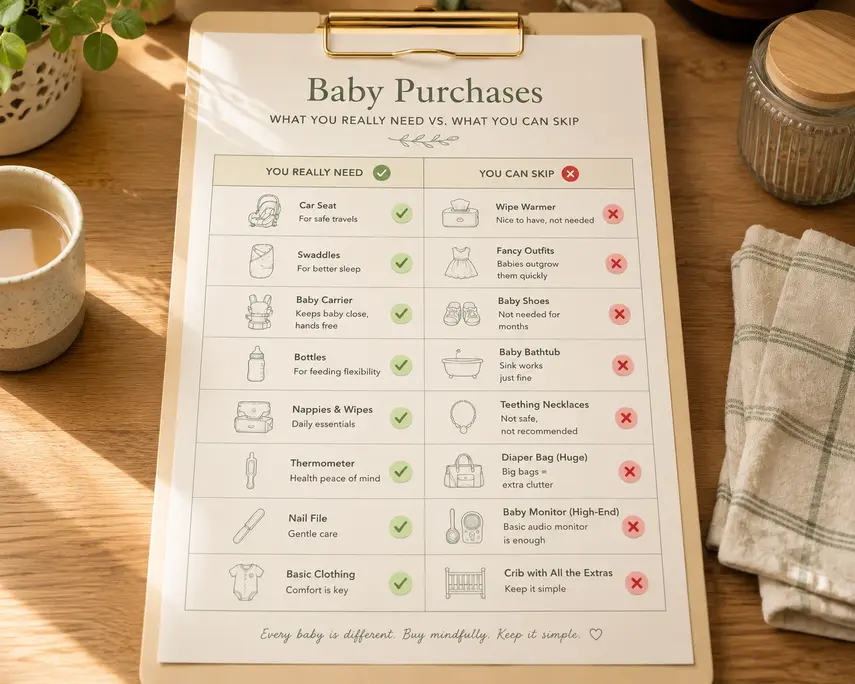
| Item | Verdict | Why | When to Buy |
| Muslin swaddle blankets (3–4) | ✅ Worth It | Versatile wrapping, burp cloth, stroller cover, shade cloth | Before birth |
| White noise machine | ✅ Worth It | Widely reported to extend sleep and settle newborns faster | Before birth |
| Rear-facing car seat | ✅ Non-Negotiable | Required by law hospitals do not discharge without one installed | Before birth, buy new only |
| Rectal thermometer | ✅ Non-Negotiable | Most accurate for infants fever in a newborn is a medical emergency | Before birth |
| Postpartum pads | ✅ Non-Negotiable | Lochia lasts up to six weeks standard pads are not sufficient | Stock before birth |
| Soft-structured baby carrier | ✅ Worth It | Frees hands, soothes baby, widely reported as daily baby essentials staple | Buy before birth, fit after |
| Nursing pillow | ✅ Worth It (if breastfeeding) | Reduces back strain during round-the-clock feeds | Before birth |
| Bottle warmer | ⚠️ Optional | Warm tap water is equally effective with no counter space required | Wait and see |
| Changing table | ⚠️ Optional | A portable mat on a low surface does the same job | Wait and see |
| Baby swing or bouncer | ⚠️ Borrow First | Baby-specific response borrow before committing to a purchase | After birth only |
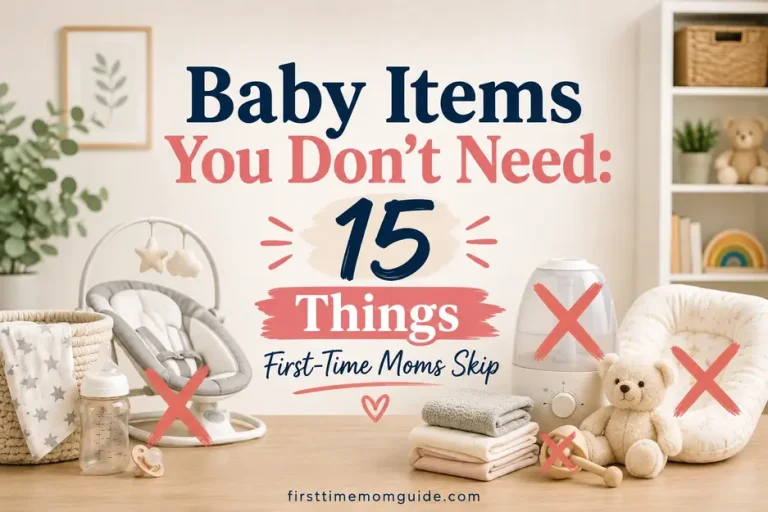
| Wipe warmer | ❌ Skip | Babies adjust to room temperature wipes within days | Remove from list |
| Crib bumpers | ❌ Never | Illegal to manufacture or sell in the US since 2022 genuine safety risk | Never |
The pattern across every trustworthy baby essential list is the same: functional, multi-purpose items with clear daily applications earn their place. Single-purpose gadgets that solve problems most parents never have or solve them only marginally better than free alternatives rarely do.
Start With the Essentials. Add Everything Else Later
The baby essentials that genuinely matter are fewer than any registry template suggests and far more specific than any store display implies. A safe place to sleep, a feeding plan, nappies, a car seat, a carrier, a white noise machine, postpartum pads, and a rectal thermometer that is the honest foundation. Everything else can wait until the baby arrives and tells you what it actually needs. Pin this guide for registry planning, share it before the baby shower, and come back for each new stage as it arrives.
Once your baby is ready for solids, read what worked when my baby refused meal.
Disclaimer:
This baby essentials guide reflects widely reported parent experience and general newborn care guidance aligned with current AAP recommendations. It is not medical advice. Always check the latest safety standards before purchasing any product, and speak with your pediatrician about feeding, sleep, and care decisions specific to your baby.
FAQ’S
1. What do you actually need for a newborn from day one?
A safe flat sleep surface, season-appropriate clothing, a rear-facing car seat, nappies across two sizes, unscented wipes, nappy cream, a feeding plan with relevant equipment, swaddle blankets, and postpartum recovery supplies for the mother. Everything beyond this short list can be added after the baby arrives once individual preferences become clear.
2. How many newborn nappies should I buy before the birth?
One to two packs of newborn size is enough, alongside one pack of size 1. Some babies skip newborn size entirely within the first ten days, particularly those born at higher weights. Stocking a large quantity of newborn size before knowing your baby’s weight is one of the most consistently reported nappy regrets across parenting communities.
3. Is a baby monitor necessary?
For most families in a standard-size home, a basic audio monitor covers the need entirely. Video monitors are widely reported as reassuring but are not clinically necessary. If your bedroom is directly adjacent to the baby’s room, many parents find they do not need one at all in the early weeks.
4. What baby items do parents most commonly regret buying?
Wipe warmers, bottle warmers, and large structured nappy bags appear at the top of nearly every list of most commonly reported wasted purchases. Themed nursery sets, novelty feeding gadgets, and large quantities of one nappy size before knowing your baby’s fit follow closely. The safest approach is to buy the minimum and add after the birth.
5. Should I add postpartum recovery items to my baby registry?
Yes and most experienced parents wish they had done this for their first baby. Postpartum pads, a peri bottle, nipple balm, nursing pads, and comfortable nursing-accessible clothing are functional necessities, not indulgences. Including them on a registry means family and friends can contribute to the mother’s recovery as well as the baby’s arrival.