Newborn Coming Home Outfit: What to Pack and What to Skip
You have the nursery set up, the car seat installed, and the hospital bag half-packed then you open the baby clothes drawer and the questions start. What size? How many layers? Snaps or zipper? What if it is cold? What if it is warm?
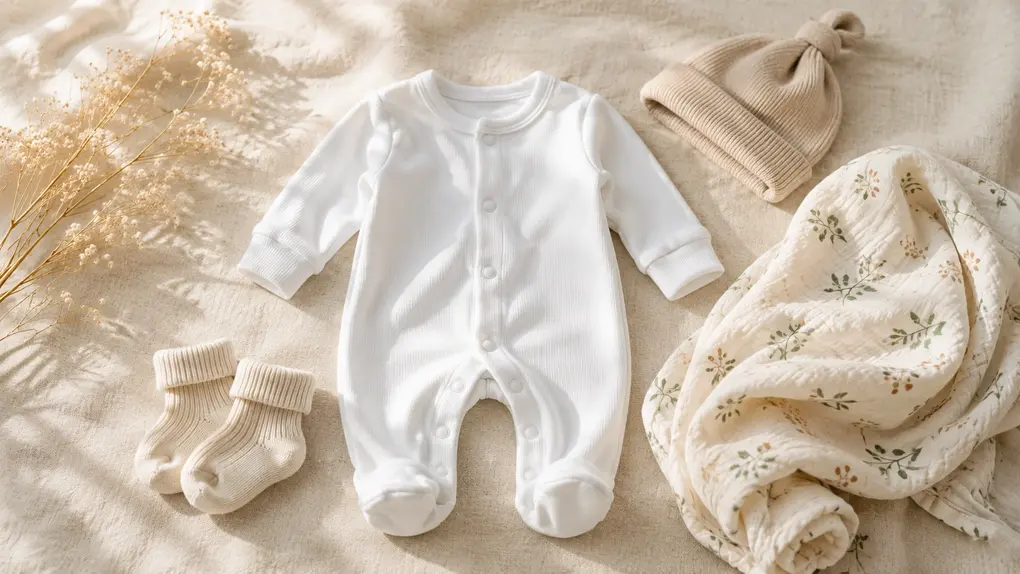
Choosing a newborn coming home outfit sounds simple until you are standing in a hospital room with a baby who is smaller than you expected, and you cannot figure out how to get their arm through the sleeve without panicking. This guide takes the guesswork out of it. Every recommendation here is based on AAP 2024 safe sleep and car seat guidelines — no filler, no guessing, just the practical answers most hospital bag guides skip over.
You will know exactly what to pack, what size to bring, how many layers to add per season, what features to look for, and the items that look useful but are not worth bringing at all.
If you are still preparing the basics, read our complete 0–3 month baby essentials checklist before packing your hospital bag.
Why the Coming Home Outfit Actually Matters
The newborn coming home outfit is not just a cute photo moment it is the first time you dress a baby alone, in a moving-out situation, under time pressure. The outfit you choose directly affects how stressful or smooth those first 30 minutes go.
Newborns cannot regulate their own body temperature. The AAP states that a newborn should be dressed in one more layer than an adult would wear comfortably in the same environment. Their skin is also extremely sensitive rough seams, tight elastic, or stiff fabric can cause real discomfort in those first hours. And the car seat adds a specific requirement: the outfit must fit under the harness correctly, with no thick padding between the baby and the straps.
What Size to Pack for a Newborn Coming Home Outfit
This is the most common packing mistake bringing only newborn size. You do not know your baby’s exact weight until birth, and a baby born at 8.5 pounds will not fit in newborn clothes from day one.
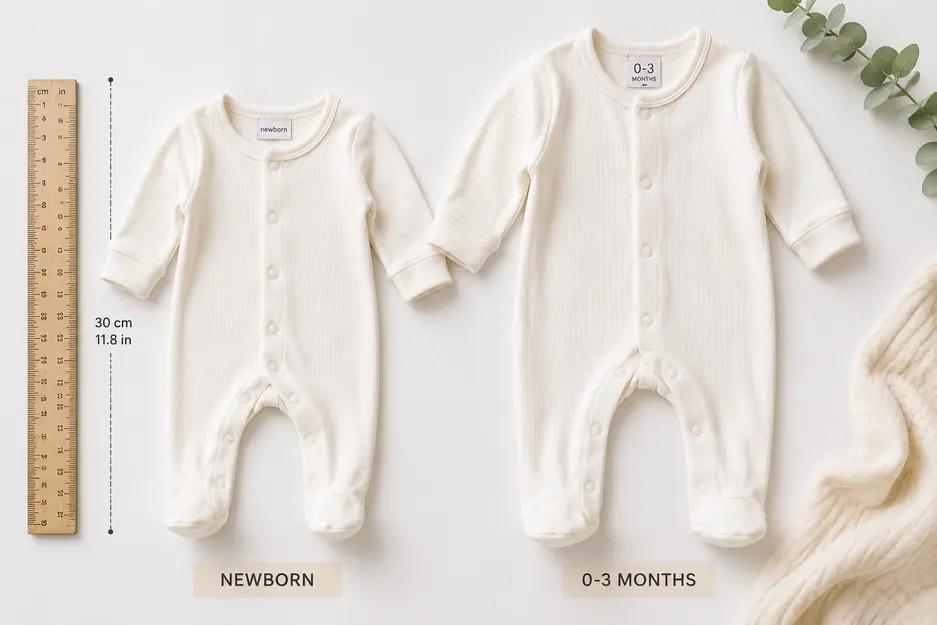
| Baby Weight at Birth | Recommended Size | Notes |
| Under 5.5 lbs (2.5kg) | Preemie or Newborn | Most hospitals stock preemie essentials confirm in advance |
| 5.5 to 8 lbs (2.5–3.6kg) | Newborn | Standard newborn size fits this range well |
| 8 to 9 lbs (3.6–4.1kg) | 0 to 3 Months | Newborn size will be too tight skip it entirely |
| Over 9 lbs (4.1kg+) | 0 to 3 Months directly | Pack both sizes but 0-3M is the safer bet |
Smart Packing: 💡
Pack one outfit in newborn size and one in 0-3 months. Bring both to the hospital. Once baby is born and weighed, use whichever fits. Return or donate the other one. This two-outfit approach is the most recommended strategy by labor nurses.
Newborn Coming Home Outfit The Exact List
The newborn coming home outfit is not a full wardrobe. It is a small, specific set of items that cover temperature regulation, easy dressing, car seat safety, and newborn skin sensitivity. Every item below earns its place for a functional reason.
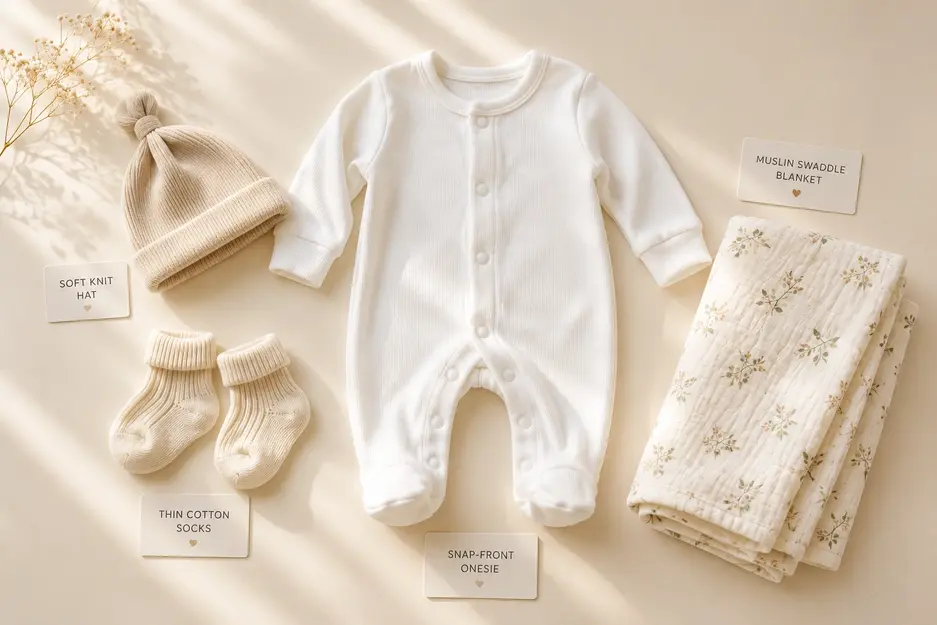
1. One Footed Onesie or Sleeper With Snaps
This is the base layer and the most important piece. Look for footed coverage it keeps tiny toes warm without separate socks that fall off. Snaps at the front or bottom are essential. You will be dressing a floppy newborn for the first time, likely in a small hospital room, possibly alone. A front-snap or bottom-snap sleeper opens completely flat so you can lay the baby on top, slide their arms in, and snap from bottom to top without lifting their legs repeatedly.
Features to look for:
- Front snaps or a two-way zip from the bottom never a pullover for hospital dressing
- Envelope neckline the folded neckline that stretches sideways, not just down
- Footed or with fold-over cuffs for the feet
- 100% cotton or organic cotton softest against newborn skin
- No decorative buttons, bows, or raised seams on the back
⚠️ Avoid:
Pullover tops with tight necklines for a newborn who cannot support their own head. Scratchy lace trim, raised back seams, or anything that requires threading tiny arms through narrow sleeves.
2. A Soft Knit Hat
Newborns lose a significant amount of body heat through their heads in the first hours after birth. Most hospitals provide a basic striped hat in the delivery room, but it stays at the hospital. Your own hat comes home with you and covers those first nights. Choose a soft knit cotton hat with no elastic band across the forehead elastic can leave marks on delicate skin and cause discomfort during a car journey.
- Material: 100% cotton knit or merino wool blend
- No tight elastic edge look for a gentle ribbed finish
- Size: One size fits most newborns covers 0 to 3 months range
- Pack two one for the hospital, one backup in the bag
3. Thin Cotton Socks (If Outfit Is Not Footed)
If you choose a non-footed sleeper or a separate outfit, pack two or three pairs of thin cotton newborn socks. Newborn socks fall off constantly this is normal. A pair of socks under a blanket in the car seat keeps feet covered even if one slips.
- Size: 0-3 months newborn-specific socks are often too small for average-weight babies
- No tight elastic cuffs these cut into circulation on tiny ankles
- Pack 3 pairs at least one will fall off before you reach the car
4. A Thin Muslin Swaddle Blanket
The swaddle blanket serves two purposes. It keeps the baby warm on the way to the car, and it goes over the car seat straps rather than under them which is the safe car seat position. A thick fleece blanket in a car seat is a safety concern because the padding compresses in a crash and creates slack in the harness. A thin muslin blanket over the top eliminates this risk while still providing warmth.
- Material: 100% muslin cotton or bamboo muslin lightweight and breathable
- Tuck over the harness, never under it or between baby and the straps
- Pack 2 swaddles in the hospital bag one stays at hospital, one comes home
5. One Cardigan or Light Jacket (Weather Dependent)
For cold weather under 15°C (60°F) add a thin cotton cardigan or a lightweight fleece jacket over the base onesie. The cardigan goes over the onesie, but baby is still strapped into the car seat in just the base layer the cardigan goes back on after strapping. For warm weather above 22°C (72°F) a single layer onesie with a muslin blanket over the car seat harness is sufficient.
| Weather | Outfit Layers | Car Seat Rule |
| Very warm — above 24°C (75°F) | Single layer onesie only | Thin muslin over harness if needed |
| Mild — 18 to 24°C (65–75°F) | Onesie + hat + socks | Muslin swaddle over harness |
| Cool — 12 to 18°C (54–65°F) | Onesie + cardigan + hat + socks | Cardigan removed before strapping in |
| Cold — below 12°C (54°F) | Onesie + fleece suit + hat + socks | Fleece suit removed; thin blanket over harness |
What to Skip — Items That Look Useful But Are Not
The items on this list appear on almost every hospital bag checklist. They are not necessary for the going-home outfit, and some create real practical problems you do not need in those first hours.
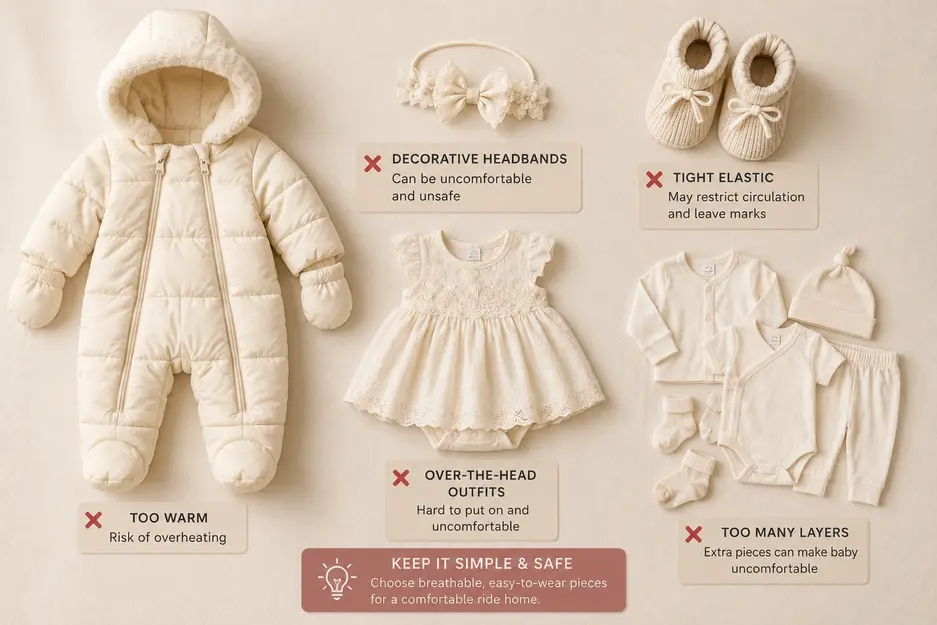
❌ Thick Snowsuit or Bunting Bag
A thick snowsuit or all-in-one bunting looks warm and practical for winter. The problem is the car seat. You cannot safely strap a baby into a rear-facing car seat while wearing a puffy suit the padding compresses in a crash and creates dangerous slack in the harness. Dress baby in a thin base layer, strap in safely, and use a blanket or the bunting bag backwards over the front after strapping.
❌ Newborn Shoes
Newborn shoes are for photos. They serve no functional purpose, they fall off within minutes, and they are genuinely difficult to put on a baby who curls their toes. Footed onesie or thin socks keep feet warm without the struggle. Save shoes for when your baby can actually stand.
❌ Decorative Headbands with Hard Embellishments
A headband with a large bow or flower looks beautiful in photos but is uncomfortable for a newborn who will be lying against a car seat head support for the entire journey. Hard embellishments press into delicate skulls. If you want a headband for photos, put it on for the picture and remove it before getting in the car.
❌ Over-the-Head Dresses or Tops
Any item that goes over the head is difficult to put on a newborn who cannot support their own neck. This is not a matter of skill a first-time parent, alone in a hospital room, navigating a narrow neckline over a soft, wobbly head is genuinely stressful. Save pullover tops for when your baby has better neck control, around 3 to 4 months. For the hospital, snaps and zips only.
❌ A Full Matching Set of Five Pieces
A coordinated outfit set with a bodysuit, pants, cardigan, hat, socks, and bib looks perfect in a flat lay photo. In practice, dressing a newborn in six separate pieces takes three times as long, involves multiple potential meltdowns, and results in half the pieces falling off in the car. One footed onesie does the job of three separate pieces. Simple wins.
Newborn Coming Home Outfit by Season
The most common question about the newborn coming home outfit is how to dress a baby for the weather. The answer is always the same formula: one more layer than an adult would wear comfortably in the same temperature and nothing thick under the car seat harness.
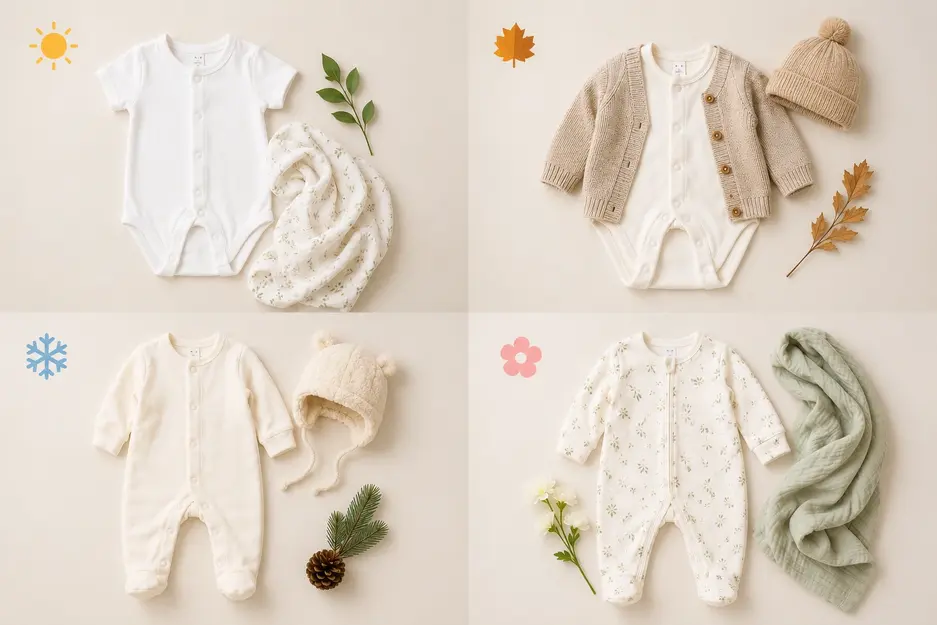
Spring and Autumn
Temperatures between 15 and 22°C (60–72°F). A footed onesie in cotton, a soft knit hat, and a muslin swaddle over the car seat straps. If the morning is cool, add a light cotton cardigan that can be removed before strapping into the car seat.
Summer
Temperatures above 22°C (72°F). A single layer short-sleeve onesie with no feet is fine if the car or transport is air-conditioned. In direct sun or without air conditioning, add a thin long-sleeve layer to prevent sunburn on fragile newborn skin. A light muslin swaddle is still useful to shield from direct air conditioning vents.
Winter
Temperatures below 10°C (50°F). A footed fleece sleeper over a thin cotton onesie provides warmth without bulk. The fleece layer must come off before strapping into the car seat dress baby in the thin cotton onesie for the car journey, then wrap in a warm blanket over the harness. The fleece suit can go back on once you arrive home.
💡 Quick Rule:
Dress for the car, not for the walk to the car. The car will be warm within minutes. A baby overdressed in a warm car is uncomfortable and potentially dangerous. Bring layers you can remove easily.
What the Hospital Provides So You Do Not Overpack
Most parents significantly overpack for the hospital stay because guides list everything imaginable without telling you what the hospital already covers. Knowing what is provided saves space in your bag and reduces the number of decisions you need to make.
| Item | Hospital Provides? | Bring Your Own? |
| Diapers for hospital stay | ✅ Yes — most hospitals | Not needed for stay; pack 4-6 for the ride home |
| Baby blankets for ward | ✅ Yes | Pack 1-2 of your own to take home |
| Basic striped baby hat | ✅ Yes — delivery room | Pack your own — hospital hat stays there |
| Wipes for hospital stay | ✅ Yes — usually | Pack travel pack for the car |
| Going-home outfit | ❌ No | This is entirely your responsibility |
| Formula (if not breastfeeding) | ✅ Most hospitals provide | Confirm with your specific hospital in advance |
| Car seat | ❌ Never | Required — hospital will not discharge without one |
| Nursing bra / pump | ❌ No | Pack your own if breastfeeding |
Complete Newborn Coming Home Outfit Checklist
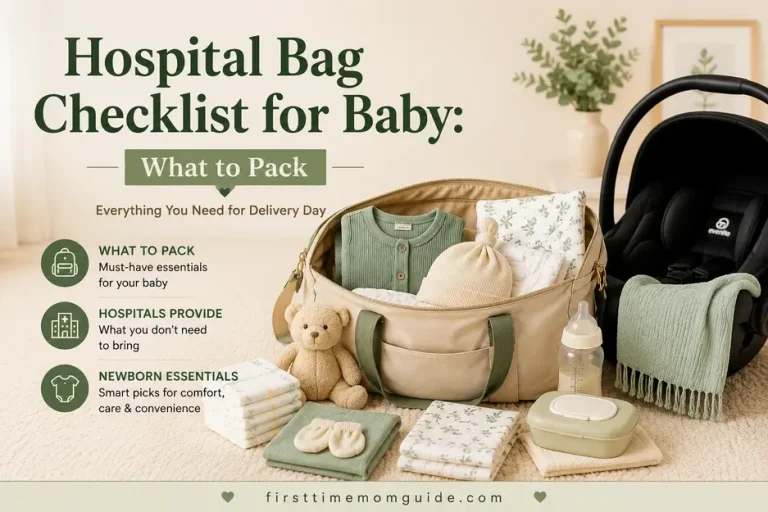
Print this checklist and tick each item off when it goes into the bag. Pack it in a separate zip bag labelled ‘Going Home’ so hospital staff can find it easily and you are not searching through a full bag while managing discharge paperwork.
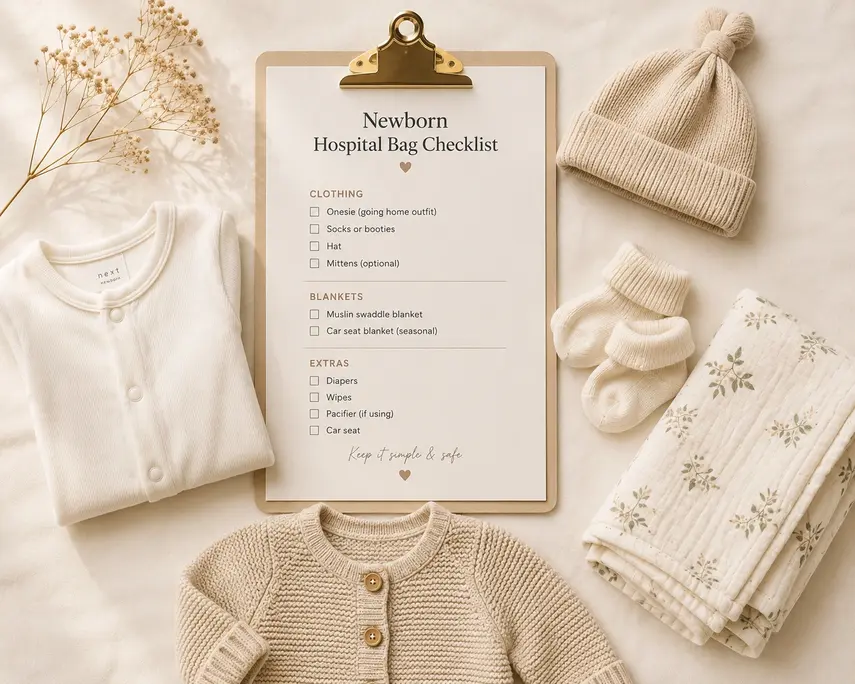
Baby’s Going-Home Bag (separate zip bag):
- 1 x footed onesie newborn size
- 1 x footed onesie 0 to 3 months size
- 2 x soft cotton knit hats
- 3 x thin cotton socks (pairs)
- 2 x muslin swaddle blankets
- 1 x light cardigan or fleece jacket (weather appropriate)
- 4 to 6 x nappies for the ride home
- 1 x small pack of baby wipes
Non-clothing essentials (not the outfit but always forgotten):
- Rear-facing infant car seat installed and inspected before 36 weeks
- Phone charger for the hospital room and the car journey home
- Nappy bag packed and, in the car, already
The Coming Home Outfit Is Simpler Than You Think
The newborn coming home outfit does not need to be complicated, coordinated, or Pinterest-perfect. It needs to be warm enough, easy to put on, safe for the car seat, and gentle against newborn skin. One footed onesie in two sizes, a hat, socks, a muslin blanket, and something for the weather that is genuinely all you need.
Pack the bag by 35 weeks. Label the going-home zip bag separately. And when you are standing in that hospital room trying to dress your baby for the first time reach for the snaps, not the pullover. You have already done the hard part.
If you are preparing emotionally for newborn life, read First Year Mom Guide Every New Mother Needs
⚠️ Disclaimer:
This article is for informational purposes only. Clothing and outfit recommendations are based on AAP 2024 safe sleep and car seat guidelines. For specific concerns about your newborn’s health or temperature regulation, always speak with your pediatrician.
FAQ’S
Q1. What size coming home outfit should I buy for my newborn?
Pack both newborn size and 0-3 months size. You do not know your baby’s exact weight until birth. A baby born at 8 pounds will not fit comfortably in newborn size from day one. Most experienced labor nurses recommend the two-outfit approach bring both, use whichever fits after the baby is weighed, and return the other. For the going-home outfit specifically, 0-3 months is the safer single choice if you only want to pack one because it allows more room and will not be too tight.
Q2. How many layers should I dress my newborn in to go home?
The AAP guideline is one more layer than you would wear comfortably in the same temperature. In mild weather, that means a single-footed onesie plus a hat. In cold weather, that means a footed onesie, a light cardigan, a hat, and socks with the cardigan removed before strapping into the car seat and a blanket over the harness instead. Never use a thick puffy suit under car seat straps. Dress for the car temperature, not the outside air temperature.
Q3. Can I put a snowsuit on my newborn for the car ride home?
Not under the harness straps. The AAP is clear on this: puffy suits, thick blankets, and padded outerwear compress in a crash and create dangerous slack in car seat harness straps. This slack means the harness no longer holds the baby safely. The correct approach is to dress baby in a thin layer, strap them in, and place the snowsuit backwards over the front or use a warm blanket draped over the harness for the journey. Once you arrive home, the snowsuit can go on normally outside the car.
Q4. Does my newborn need shoes for the coming home outfit?
No. Newborn shoes are purely decorative. A newborn’s feet are curled and cannot be straightened into a shoe without significant effort, and the shoe will fall off within minutes regardless. Footed onesies or thin cotton socks keep feet warm far more effectively. If you want a photo with shoes, take it in the hospital room before the car journey then remove them before strapping in.
Q5. What if I do not know the baby’s sex before birth how do I pack the outfit?
Pack white, cream, yellow, or mint green these neutral colours work for any baby and photograph beautifully. Many parents specifically choose gender-neutral colours for the going-home outfit so the photos remain timeless regardless. Focus on the practical features snaps, soft cotton, footed coverage rather than the color. The outfit matters far less than its functionality on the day.