6-12 Month Baby Essentials: What to Buy & Skip
One day your baby is lying peacefully on a play mat, batting at a toy above their head, content with the world exactly as it is. A few weeks later, they are grabbing for your dinner plate, crawling toward the nearest electrical outlet with surprising speed, and pulling themselves up on the coffee table while you are still holding your coffee.
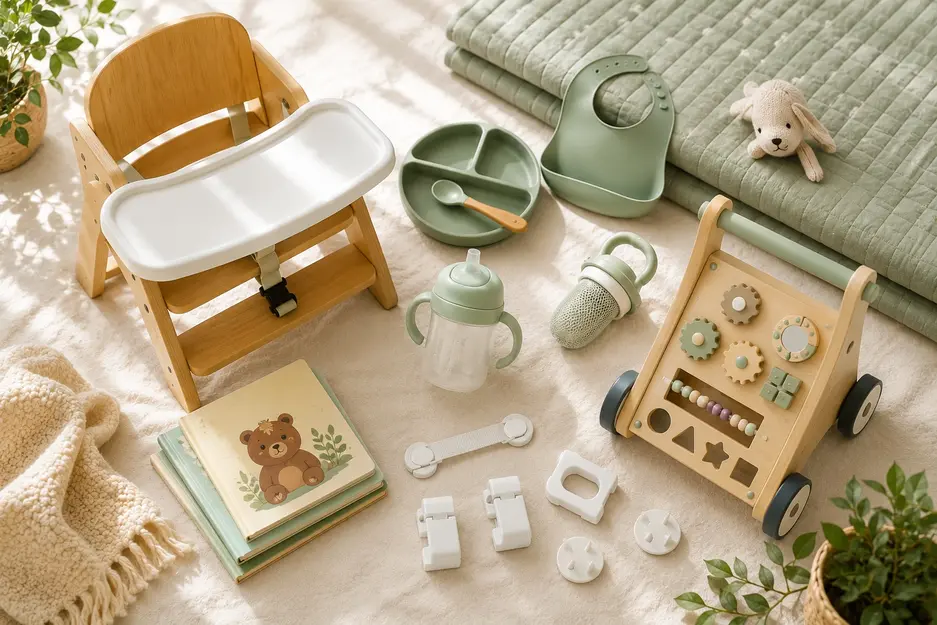
Most parents research baby gear thoroughly before birth. The crib, the car seat, the bassinet all sorted months in advance. Then month 6 arrives, and almost none of that preparation applies anymore. The gear that got you through the first six months is either wrong, retired, or not yet bought. And unlike the newborn stage where everything is prepared in advance, the 6–12-month stage catches most parents off guard.
This guide covers every 6–12-month baby essential what it is, exactly when you need it, and what to skip. Every item connects to a specific developmental milestone. Nothing is added for marketing reasons, and the timing comes from a mix of official guidance and what families consistently report needing in real life.
For newborns, start with our 0 to 3 Months Baby Essentials guide.
Quick Checklist: 6-12 Month Baby Essentials at a Glance
Before the full guide, here is everything you need across this stage in one scannable table. Tick what you already have. Focus your attention on what is missing especially anything listed a month or two before your baby’s current age.
| Month | Must Add Now | Start Researching |
| 6 months | High chair, soft spoon, suction bowl, silicone bib | Baby-proofing supplies |
| 7 months | Soft finger foods gear, mesh feeder, straw cup | Push walker, crawling mat |
| 8 months | Baby-proof latches, outlet covers, stair gate | Convertible car seat |
| 9 months | Push walker or ride-on toy, board books | Toddler shoes (soft sole) |
| 10 months | Sippy or straw cup, bath seat upgrade | First birthday gear |
| 11-12 months | Convertible car seat, soft sole shoes | Toddler plates + cutlery |
💡 How to Use This
Read each section below for the full reasoning behind every item and when exactly you need it. The checklist gives you the timeline the guide gives you the why.
What Changes Between 6 and 12 Months
The second six months of your baby’s first year are the most physically dramatic months of human development. A baby who cannot sit at 6 months is typically walking by 12 months. Every month brings a new milestone and each one requires different gear, different home preparation, and a different level of supervision.
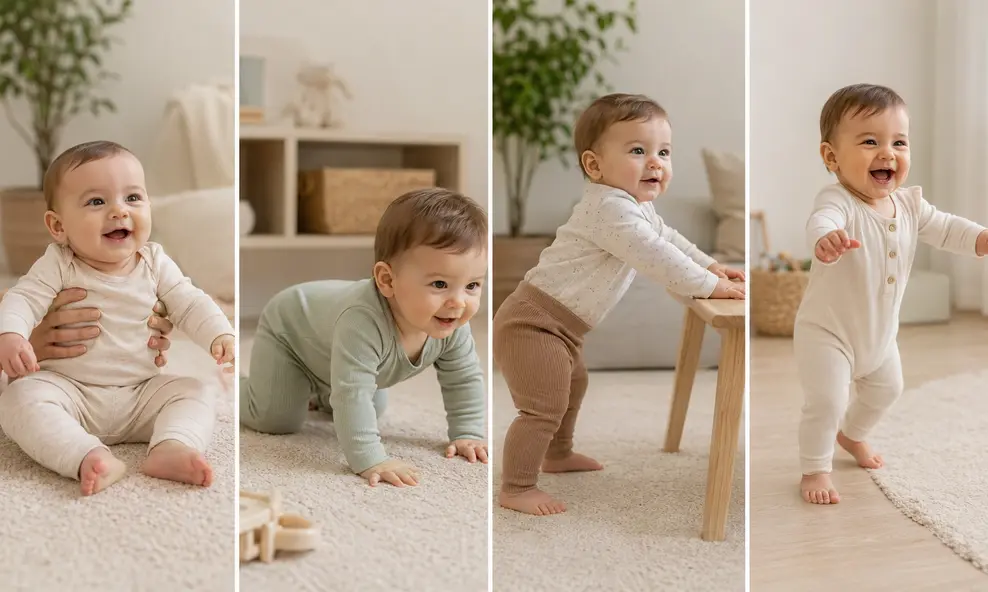
Understanding the milestones tells you exactly what to buy and when:
- 6 months: Sits with support, starts solid foods, reaches and grasps deliberately
- 7 months: Sits without support, begins exploring textures and tastes
- 8 months: Crawling begins, pulls on furniture, separation anxiety peaks
- 9 months: Cruising along furniture, fine pincer grasp developing
- 10 months: Standing with support, beginning to wave and clap
- 11 months: Cruising faster, may take first unsupported steps
- 12 months: Walking begins, first words emerging, transitioning to cow’s milk
6-12 Month Baby Essentials: Complete Guide by Category
Each category below follows the same logic: what it is, why it matters developmentally, and exactly when to buy it. Feeding has the most new items to think about, but it is not the only category that changes your home, your sleep routine, and your car all need attention during this stretch too.
Feeding Essentials 🍽️
Feeding brings the biggest shopping list of this entire stage and the one was timing trips people up most. Many parents discover the hard way that ordering a high chair the week solids start means a few days of feeding a wriggly baby on their lap, sofa cushions everywhere. Getting this section sorted early makes the first weeks of solids feel manageable instead of chaotic.

High Chair: Buy Before 6 Months Arrives
A high chair is the single most important purchase of this stage. Without one, introducing solid foods comfortably is genuinely difficult. Good chairs often have a 4-to-6-week delivery wait, so research at 4 to 5 months and buy by 5.5 months at the latest.
Look for
adjustable footrest, removable tray, recline option, and a wipeable seat pad.
Skip
fabric seats, chairs with no footrest, and walker-style feeding seats that attach to the table.
The Rest of the Feeding Kit
A handful of smaller items round out the feeding setup, and most parents end up buying these in a single order alongside the high chair: 3 to 4 soft-tipped silicone spoons small enough for baby’s mouth, a suction bowl that stays put on the tray (add a suction plate by 9-10 months for self-feeding), 3 to 4 silicone bibs with a food-catch pocket the most-used item of the whole stage, a mesh food feeder for safe exploration of fruit and frozen teething relief, and a straw cup from 6 to 7 months for water alongside meals.
Play and Development Essentials 🧸
As your baby moves from lying and sitting to crawling and pulling up, their play needs change just as fast as their bodies do. Each item below matches a specific stage of that movement, and most families find they reach for two or three of every single day once baby is mobile.

Crawling Mat or Large Play Mat
Once crawling begins usually between 7 and 10 months your baby needs a safe, padded surface to explore. A large foam or quilted mat protects knees and gives enough space for real movement. Choose one that wipes clean easily, because it will need to.
Push Walker: From 9 to 10 Months
A push walker is a wheeled toy your baby holds onto and pushes while learning to walk. It builds balance and confidence in upright movement. Most babies are ready for a push walker between 9 and 11 months.
⚠️ Important:
This is a push walker, not a baby walker the seated rolling kind. In real life, many parents are surprised to learn that seated walkers are actively discouraged because they delay walking development and cause thousands of injuries every year. Push walkers are safe and genuinely helpful. Seated rolling walkers are not.
Board Books: From 6 Months
Board books are not optional extras they are developmental tools. Reading to your baby from 6 months builds language, vocabulary, and pre-literacy skills, and starting now means it becomes a natural part of the bedtime routine before your baby is old enough to resist it. Choose books with simple images, high contrast, and short text. Have at least 6 to 8 within reach at all times.
Stacking Toys and Shape Sorters: From 8 Months
By 8 to 9 months, your baby’s pincer grasp picking up small objects with thumb and index finger is developing rapidly. Stacking cups, chunky rings, and simple shape sorters give this developing skill something purposeful to practice.
Soft Fabric Balls and Sensory Items
Balls roll, which means babies chase them, which means more crawling, more movement, and more development. A set of soft balls in different textures keeps your baby engaged and active during floor play.
Baby-Proofing 🔒
Baby-proofing is the category most parents delay until their baby has already reached something dangerous. In real life, this becomes important faster than expected most babies begin crawling between 7 and 10 months, but some surprise their parents by moving weeks earlier than the books suggest. The rule that works: baby-proof before crawling begins, not after, and aim to have your home ready by month 6 to 7.
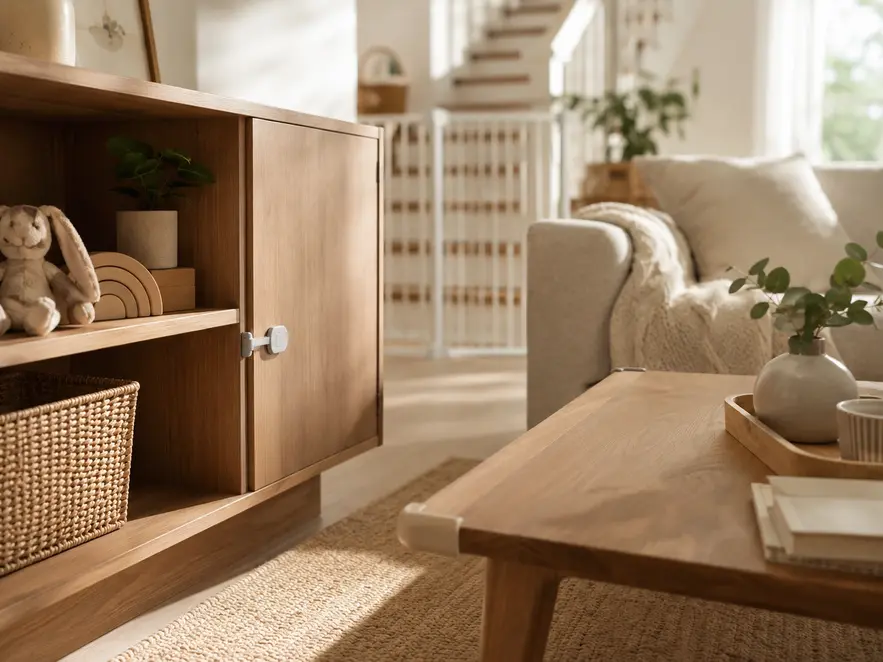
A full baby-proofing pass covers more ground than most parents expect on the first walk-through. Get down on the floor at your baby’s eye level it changes everything you notice.
Cabinet Safety Latches
Install magnetic or spring latches on every cabinet your baby can reach especially under the sink, cleaning products, and anywhere with small items. Magnetic latches are harder for babies to figure out than spring latches, and worth the slightly higher price for the cabinets that matter most.
Outlet Covers
Standard outlet plug covers are sufficient for most households. Sliding outlet covers that replace the entire outlet plate are harder to remove and provide more complete protection, particularly in rooms where your baby spends the most time.
Stair Gates
A stair gate at the top of every staircase is non-negotiable once your baby is mobile. Install it before crawling begins. A gate at the bottom is useful but less critical babies climbing upstairs with supervision is actually good development. Falling down stairs is not.
Corner Guards and Furniture Anchoring
Coffee tables, entertainment units, and fireplace hearths with sharp corners sit at exactly baby head height foam corner guards protect the most common impact points. Just as important, and often missed: bookshelves, dressers, and any tall furniture must be anchored to the wall before your baby can pull to stand. Tip-over accidents are one of the leading causes of infant injury in the home, and this is the kind of thing that takes ten minutes with a drill but genuinely changes the safety of a room.
Car Seat Transition 🚗
Your infant car seat has both a weight limit and a height limit, and in real life it is usually the height limit that catches families out first not the weight one parents tend to watch for.
Most infant seats allow rear-facing up to 30 to 35 pounds, which means many babies do not outgrow them by weight until 2 to 3 years old. However, the height limit usually around 30 to 32 inches is often reached much earlier, sometimes as early as 9 months for taller babies.
Check your infant seat’s manual now, even if it feels early. If your baby is approaching either limit, begin researching convertible car seats so you are not shopping under pressure.
Convertible Car Seat: Start Researching at 9 Months
A convertible car seat rear-faces to higher weights, typically 40 to 50 pounds, then converts to forward-facing later. Current guidance favors keeping children rear-facing as long as possible until they reach the seat’s rear-facing weight or height limit, not simply until they turn 1. Many families are surprised how long rear-facing actually lasts once they switch to a convertible seat with a higher limit.
Do not rush to forward-face. Rear-facing remains significantly safer at every stage, and a few extra months rear-facing in a convertible seat is a small adjustment for everyone in the car.
First Shoes 👟
Babies do not need shoes until they are walking outdoors. Before that, bare feet or soft-sole socks indoors are ideal bare feet provide the most sensory feedback for developing balance, and many parents find their baby walks better barefoot at home even once outdoor shoes are in the wardrobe.
When first shoes are needed, look for: soft sole shoes for the first 1 to 3 months of walking, a flexible sole that bends easily with the foot, a wide toe box since baby feet are naturally wide, and secure fastening that will not slip off mid-step.
Skip
Hard-sole shoes for non-walkers, shoes with no flexibility in the sole, and shoes bought months in advance baby feet grow surprisingly fast and a perfect-fit pair today may not fit in six weeks.
Bath Time 🛁
Bath time changes shape once your baby can sit with support, usually from around 6 months and for a lot of families, this is the point where bath time goes from a two-person job to something one parent can manage solo most nights
Bath Seat or Bath Ring: From 6 Months
Once your baby can sit with support, a bath seat or ring lets them sit upright in the tub while you wash them significantly easier than the newborn bath position, and most babies enjoy it far more. It also frees up a hand, which matters more than it sounds like it should at the end of a long day.
⚠️ Safety Rule:
Never leave your baby alone in a bath seat, even for a moment. Bath seats prevent tipping they do not prevent drowning. Stay within arm’s reach at all times, with eyes on baby, not on your phone.
Bath Toys and the Wind-Down Routine
Simple bath toys stacking cups, rubber animals, pouring toys make bath time engaging and support water confidence early. Many parents also find this is the moment bath time starts becoming part of the bedtime routine, with a consistent order of bath, pyjamas, book, and bed helping signal that the day is winding down. Keep toys simple and easy to clean to avoid mold buildup in the small crevices.
Sleep🌙
Sleep in the second six months of the first year is largely about maintaining what is working and navigating regressions not adding new gear. That said, this stage often brings its own surprises, and knowing what is coming helps even when it does not stop it from happening.
Sleep Sack: Continue Using
Keep using a TOG-appropriate sleep sack through the first year. Loose blankets in the crib are not considered safe until at least 12 to 18 months, so the sleep sack remains the easiest way to keep your baby warm without anything loose in the cot.
Crib Transition if Not Already Done
If your baby is still in a bedside bassinet, transfer to a crib immediately. Most bassinets have a 4-to-6-month age or weight limit, and once your baby starts pushing up on hands and knees, a bassinet stops being a safe option regardless of the date on the label. The crib should remain empty no pillows, bumpers, positioners, or toys.
Sleep Regressions to Expect
Two regressions tend to land in this window, and many parents describe them as the moment a previously good sleeper suddenly seems to forget how to sleep. The 8-to-10-month regression is usually tied to developmental leaps crawling, pulling to stand, and a wave of separation anxiety all hit around the same time. The 12-month regression often lines up with the walking milestone and a nap transition from two naps down to one.
No product eliminates sleep regressions they pass on their own timeline. A consistent bedtime routine is the most effective tool you have, and the same routine that helps now will keep helping long after this stage ends.
Where to Spend More and Where to Save: A Budget Guide
Not everything on this list deserves the same budget. Some items genuinely benefit from spending more — they get heavy daily use, carry safety implications, or are simply frustrating when they are cheaply made. Others do the same job whether they cost five dollars or fifty, and the expensive version mostly buys you a nicer color.
| 💰 Worth Spending More On | 🪙 Save Your Money On |
| High chair used 3 times a day for years; comfort, cleanability and durability genuinely matter | Bibs buy a multi-pack of basic silicone bibs; they all catch food equally well |
| Convertible car seat a safety item your child sits in for years; this is not where to cut corners | Soft-tipped spoons a 4-pack of basic silicone spoons works exactly like the premium version |
| Stair gates a flimsy gate that a determined toddler can push open is a real risk; spend for a sturdy, properly fitted one | Bath toys household items like measuring cups and colanders do the same job as branded bath toy sets |
| Push walker a wobbly, lightweight one can tip; a stable, well-built one supports baby’s weight safely | Shape sorters and stacking toys secondhand is ideal here; toys get chewed and outgrown fast |
Real-Life Timeline: What Does My Baby Need THIS Month?
The category guide above explains the why. This section answers the question parents actually type into Google at 11pm: my baby is a certain age right now what do I genuinely need to sort out this month, not last month or next month?
| Baby’s Age | What to Focus On This Month |
| 6 months | Solids are starting now make sure the high chair, soft spoons, suction bowl, and silicone bibs are ready. Start the straw cup alongside meals. Begin a first walk-through of baby-proofing if you have not already. |
| 7 months | Baby may be sitting unsupported and exploring more textures. Finish baby-proofing if month 6 did not cover it latches, outlet covers, and corner guards. Add a mesh feeder for finger food exploration. |
| 8 months | Crawling often starts now, sometimes with very little warning. Stair gates and furniture anchors should be in place this month, not next. A crawling mat gives baby a safe base while you finish the rest. |
| 9 months | Cruising along furniture begins check your infant car seat’s height limit and start looking at convertible seats if you are close. Board books and stacking toys earn their place in daily play now. |
| 10 months | Standing with support and early cruising continue. If bath time has become a wrestle, a bath seat helps. This is also a good month to introduce a push walker if baby seems ready for upright movement. |
| 11 months | First unsupported steps may appear. Keep the convertible car seat research moving if you have not finalized it — many families switch around now. Soft-sole shoes are only needed once baby is walking outdoors. |
| 12 months | Walking, first words, and the transition toward cow’s milk and toddler routines. Revisit the Must-Have vs Nice-to-Have table most of this guide’s list should be in place by now, with only the timing of shoes and the car seat still depending on your individual baby. |
Top 10 Most Important 6-12 Month Baby Essentials If You Buy Nothing Else
If your budget or your time is limited, these ten items deliver the most safety, development, and sanity per dollar spent. Everything else in this guide is genuinely useful but this list is the one to prioritize first.
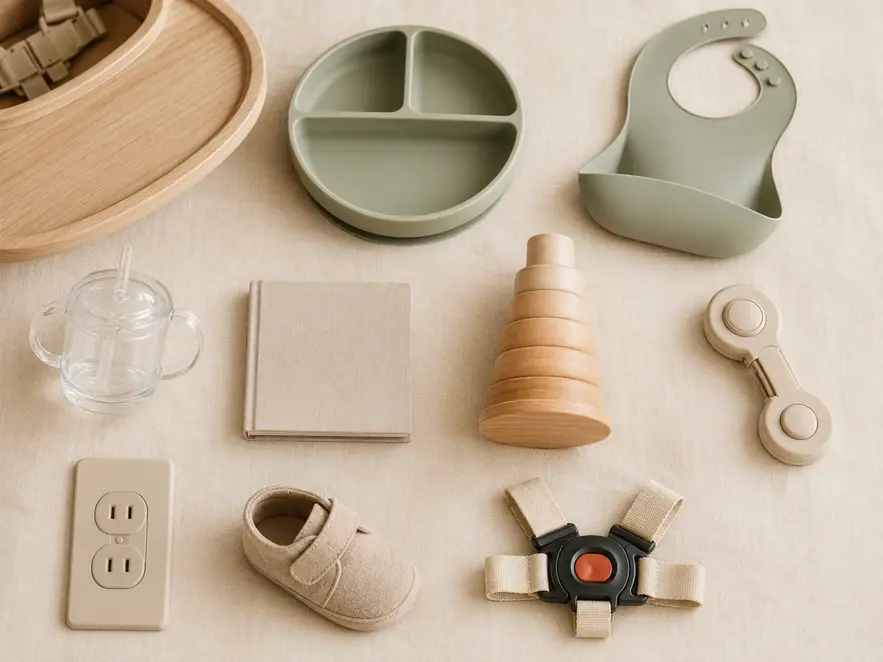
- High chair ordered by month 5, used from month 6. Nothing else on this list matters if your baby has nowhere safe to eat.
- Silicone bibs with pocket (3-4) the single most-used item of the entire stage.
- Suction bowl or plate keeps food on the tray, not the floor.
- Straw sippy cup start the bottle-to-cup transition early, not at the last minute.
- Cabinet latches and outlet covers the fastest, cheapest safety upgrade in your home.
- Stair gates (top of every staircase) non-negotiable once crawling starts.
- Furniture anchors tip-over prevention for every tall piece of furniture.
- Large crawling mat gives baby a safe zone while you finish baby-proofing the rest.
- Board books (6-8) the cheapest, highest-impact developmental tool on this entire list.
- Push walker — supports walking development the safe way, unlike seated walkers.
6-12 Month Baby Essential: Must-Have vs Nice-to-Have vs Skip
This table sorts every item in this guide into three columns. The Must-Have column is non-negotiable for safety or core development. Nice-to-Have items add real value but are not essential on day one. Skip items are either discouraged by current guidance or simply not worth the money or space.
| Item | Must Have | Nice to Have | Skip |
| High chair | ✅ By month 6 | — | — |
| Soft-tipped silicone spoons | ✅ | — | — |
| Suction bowl + plate | ✅ | — | — |
| Silicone bib with pocket | ✅ | — | — |
| Straw sippy cup | ✅ From 6-7m | — | — |
| Mesh food feeder | ✅ | — | — |
| Baby-proof latches + outlet covers | ✅ Before 7m | — | — |
| Stair gates | ✅ Before mobile | — | — |
| Large crawling play mat | ✅ | — | — |
| Board books (6-8 minimum) | ✅ From 6m | — | — |
| Push walker | — | ✅ From 9-10m | — |
| Stacking toys + shape sorter | — | ✅ From 8m | — |
| Bath seat | ✅ From 6m | — | — |
| Sleep sack (continue) | ✅ | — | — |
| Soft-sole first shoes | ✅ When walking | — | — |
| Convertible car seat | ✅ Check limit | — | — |
| Seated rolling baby walker | — | — | ❌ Avoid |
| Hard-sole shoes before walking | — | — | ❌ Skip |
| Bumper pads or crib toys | — | — | ❌ Not safe |
| Spout sippy cup | — | — | ❌ Use straw instead |
| Jumperoo / ExerSaucer (extended use) | — | — | ❌ Max 20 min/day |
5 Mistakes Parents Make Between 6 and 12 Months
The 6–12 month stage is exciting, but it also comes with a few common mistakes many parents only notice after the problem has already started. From buying feeding gear too late to delaying baby-proofing, these small misses can make everyday routines more stressful. Here are the five mistakes worth avoiding before your baby becomes fully mobile.
Mistake 1: Buying the High Chair Too Late
Best high chairs take 4 to 6 weeks to arrive. Ordering at the start of month 6 means days sometimes weeks of feeding a wriggly baby on the sofa or your lap. In real life, the families who avoid this simply moved the high chair decision up to month 4 or 5, before the urgency hit.
Mistake 2: Skipping Baby-Proofing Until After Crawling Starts
By the time your baby is crawling, they have already found three things you did not know were dangerous. Baby-proofing in advance feels like a chore with no immediate payoff until the week your baby starts moving, when it suddenly becomes the most useful thing you did all month.
Mistake 3: Using a Seated Rolling Baby Walker
Walker injuries send more than 9,000 babies to emergency rooms annually in the US alone, and several countries have restricted or banned their sale entirely. They have also been linked to delayed walking development. A push walker gives the same upright-movement fun without either risk.
Mistake 4: Not Checking the Infant Car Seat Limits
Parents often assume their infant seat lasts the whole first year. It may not especially the height limit, which many babies reach well before their first birthday. A five-minute manual check now avoids a stressful scramble later.
Mistake 5: Forward-Facing the Car Seat Too Early
Many parents forward-face at 12 months thinking the year mark is the signal to switch. It is not. Current guidance favors rear-facing as long as the seat allows often well past the first birthday because it remains meaningfully safer at every stage.
You Are Ready for This Stage 6-12 Month Baby Essentials, Sorted
Somewhere in the next six months, your baby will go from a small person who needs to be placed somewhere to a small person who decides where they are going. They will figure out how to get onto the sofa, into the cabinet you forgot to latch, and eventually onto their own two feet and they will do it faster than feels possible while you are living through it.
None of the gear in this guide replaces the part where you watch that happen. It just means that when it does — when your baby suddenly sits up, or crawls across the room for the first time, or stands holding the coffee table grinning at you you are not scrambling for a high chair, patching a cabinet with tape, or realizing the car seat does not fit anymore. You get to just watch it happen.
Save this guide and come back to it each month. The 6–12-month baby essentials are not about having everything ready on day one they are about staying one small step ahead of a baby who is changing faster than anyone warned you they would.
If your baby is younger, read our 3-6 Month Baby Essentials guide first.
FAQ’S
Q1. When should I buy a high chair for my baby?
Buy your high chair by 5 to 5.5 months not at 6 months. best high chairs have a 4-to-6-week delivery window, and solid foods typically begin around 6 months. If you wait until month 6 to order, you will not have it when you need it. Prioritize an adjustable footrest, a removable washable tray, and a seat that wipes clean easily. Avoid fabric seats and chairs without footrests.
Q2. When should I start baby proofing my home?
Start baby-proofing by 6 to 7 months before crawling begins, not after. Most babies start crawling between 7 and 10 months, though some begin earlier. Key items: cabinet latches on every accessible cabinet, outlet covers throughout the home, stair gates at the top of every staircase, and anchoring for all heavy furniture that could tip. Corner guards for sharp coffee table edges are worth adding too. Once your baby is mobile, baby-proofing becomes reactive and reactive is too late.
Q3. Are baby walkers safe for 6–12 month-old babies?
Seated rolling baby walkers are widely discouraged. They cause more than 9,000 emergency room injuries in the US every year and have been linked to delayed walking development babies who use them tend to walk a few weeks later than those who do not. Several countries have restricted or banned their sale. A push walker a wheeled toy your baby stands behind and pushes is the safe alternative that actually supports walking skills.
Q4. When do babies need their first shoes?
Babies do not need shoes until they are walking outdoors. Before that, bare feet are ideal they provide the best sensory feedback for balance and walking development. When first outdoor shoes are needed, choose soft-sole shoes with a flexible base, a wide toe box, and secure fastening. Avoid hard-sole shoes for early walkers they restrict natural foot movement and reduce the sensory feedback that helps with balance.
Q5. When should I switch from an infant car seat to a convertible car seat?
Switch when your baby approaches either the weight or height limit of your infant seat whichever comes first. Most infant seats allow rear-facing to 30-35 pounds, but the height limit of around 30-32 inches is often reached first, sometimes between 9 and 14 months. Check your specific seat’s manual for exact limits. Current guidance favors keeping children rear-facing as long as the convertible seat allows, not simply until they turn 1.