
Baby Sleep Guide for First-Time Moms: Better Sleep Starts Here
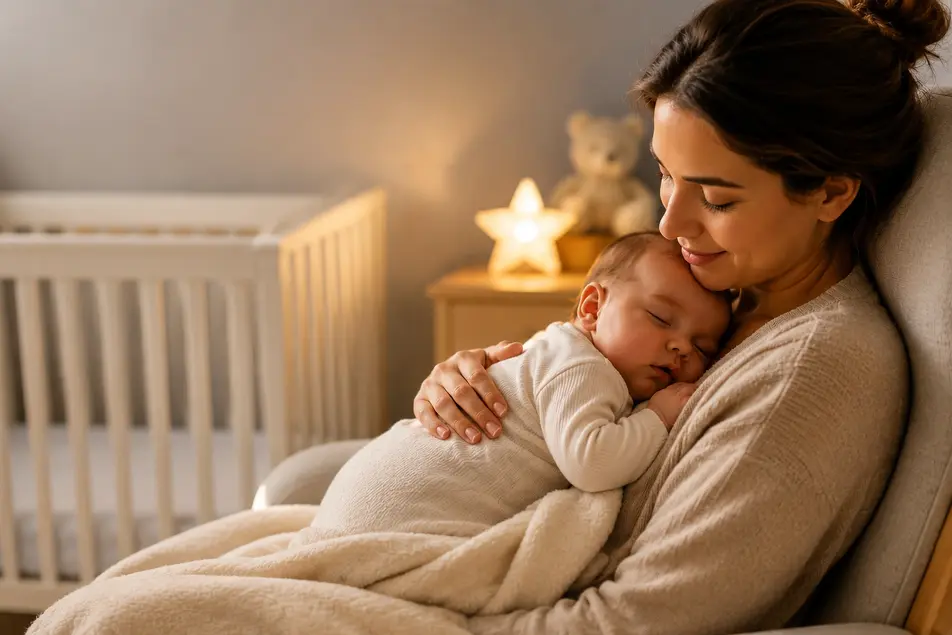
It is 2 AM. You have rocked, fed, shushed, and swayed — and the moment your back hits the bed, those eyes pop open again.
If this is your night right now, you are not failing. Baby sleep is one of the hardest parts of the first year — and one of the most searched topics by new moms for exactly this reason.
This guide covers everything: safe sleep rules, baby sleep schedules by age, wake windows, bedtime routines, sleep training methods, and regressions. Every claim here comes from real AAP guidelines or published pediatric research. No guessing. No myths.
Bookmark this page you will come back to it more than once.
If you are first time mom then you must need to read the baby sleep guide for better sleep plan for baby and you.
Safe Baby Sleep: The Rules That Never Change 🛏️
Before routines, wake windows, or any sleep method — safe baby sleep comes first. These are not suggestions.
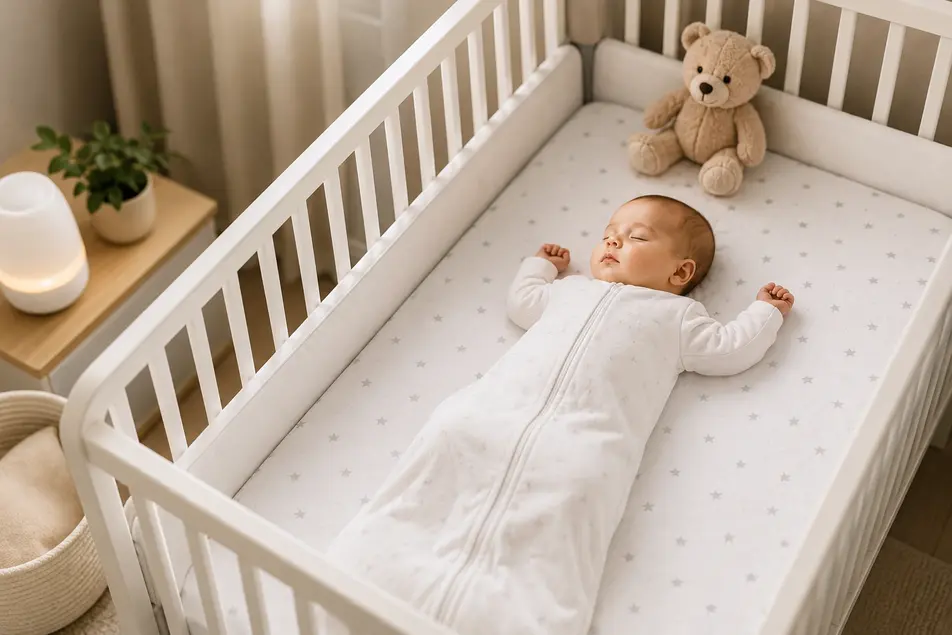
The American Academy of Pediatrics uses the ABCs of safe sleep:
- A — Alone: Baby sleeps alone in their own space. No adults, siblings, or pets in the same sleep surface.
- B — Back: Every sleep, every nap — baby on their back until age 1.
- C — Crib: Firm, flat surface only — an approved crib, bassinet, or play yard.
The crib must contain only baby:
- No pillows, no loose blankets, no bumper pads, no positioners, no stuffed animals
- One firm fitted sheet only
- A sleep sack (wearable blanket) is the safe alternative to loose blankets
Room conditions for safe baby sleep:
- Temperature between 68–72°F / 20–22°C
- If baby feels warm on the chest or upper back, remove one layer
- Pacifier at sleep time is safe after breastfeeding is well established — research links it with lower SIDS risk
Never place baby to sleep on:
- Adult beds, sofas, or armchairs — even for a short nap
- Inclined sleepers — recalled by the CPSC due to documented infant deaths
- Bouncers or swings for unattended sleep
Practical tip 💡
Place a worn piece of your clothing near — never inside — the crib. Your scent is calming and can ease the arms-to-mattress transition.
Baby Sleep by Age: What Is Actually Normal ⏰
Baby sleep totals shift every few months in the first year. What is normal at 6 weeks looks completely different at 9 months.
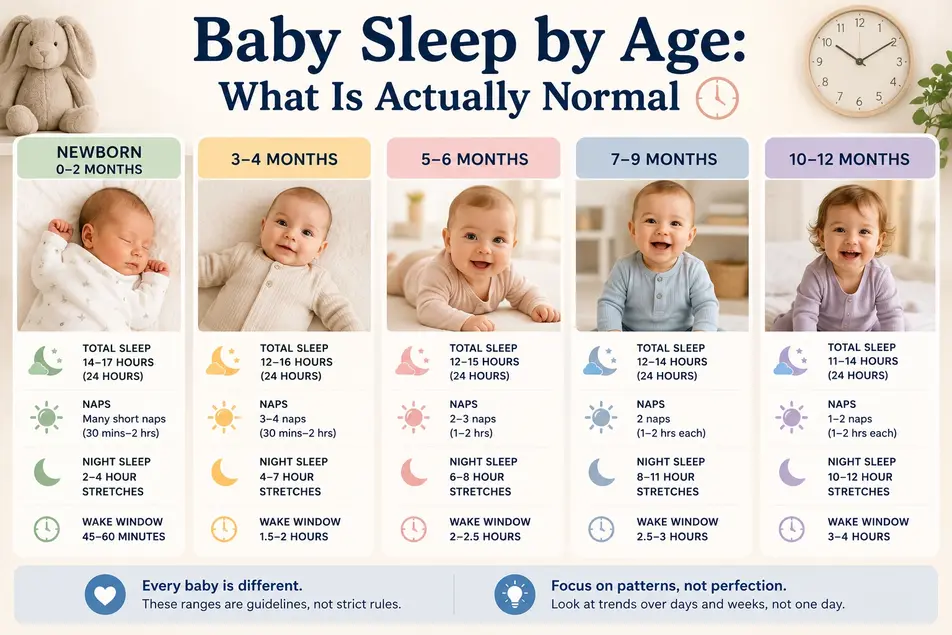
| Age | Total Sleep (24 hrs) | Typical Night Sleep | Naps Per Day |
| 0–3 months | 14–17 hours | 8–9 hrs (with feeds) | 4–5 short naps |
| 4–6 months | 12–15 hours | 10–11 hours | 3 naps |
| 7–9 months | 12–14 hours | 11 hours | 2 naps |
| 10–12 months | 11–14 hours | 11–12 hours | 1–2 naps |
What this table does not tell you:
These numbers are averages from the National Sleep Foundation. A baby sleeping slightly more or less is not automatically a problem. Weight gain, alertness during wake windows, and milestone progression matter far more than hitting an exact hour count.
Newborns cycle through sleep stages every 45–60 minutes. Waking between cycles is biologically normal — it is how infant baby sleep is structured, not a flaw to fix.
Wake Windows: The Tool Most Parents Never Hear About 🕐
A wake window is the amount of time your baby can stay comfortably awake between one sleep and the next. Go past the window and baby becomes overtired. An overtired baby releases cortisol — a stress hormone — which makes falling asleep harder, not easier.
| Age | Wake Window |
| 0–6 weeks | 45–60 minutes |
| 6–12 weeks | 60–90 minutes |
| 3–4 months | 1.5–2 hours |
| 5–6 months | 2–2.5 hours |
| 7–9 months | 2.5–3 hours |
| 10–12 months | 3–4 hours |
Tired cues to watch before the window closes:
- Eye rubbing
- Yawning — even once
- Pulling or touching ears
- Staring blankly, losing interest in surroundings
- Sudden fussiness after a happy stretch
When you spot two or more of these, start your wind-down immediately. Watching the clock and watching your baby together gives the best results.
Baby Sleep Routine: The 20-Minute Sequence 🌙
A consistent bedtime routine is one of the most evidence-backed tools for improving baby sleep. Multiple pediatric studies confirm that babies with a regular routine fall asleep faster, wake less at night, and sleep longer stretches within 2–4 weeks of starting.
You do not need expensive products. You need repetition.
A consistent bedtime routine is one of the most evidence-backed tools for improving baby sleep. Multiple pediatric studies confirm that babies with a regular routine fall asleep faster, wake less at night, and sleep longer stretches within 2–4 weeks of starting.
You do not need expensive products. You need repetition.
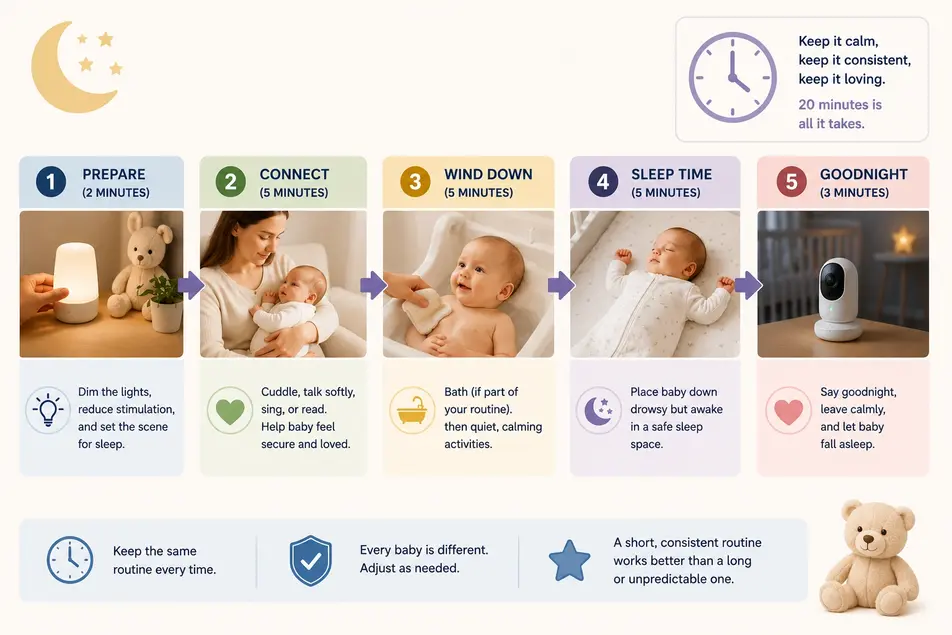
Step 1 — Warm Bath (5 minutes) Body temperature drops after a warm bath, which naturally signals sleepiness. A warm washcloth wipe-down works on nights you skip the full bath.
Step 2 — Gentle Massage (3 minutes) Slow circular strokes on the tummy and legs with unscented baby lotion. Research shows infant massage lowers cortisol in both baby and parent.
Step 3 — Feed Breast or bottle comes before the final step — not during or after. Feeding to sleep creates a sleep association that causes waking every cycle when baby needs to recreate it.
Step 4 — Dim Everything Lower all lights at least 30 minutes before bed. Darkness triggers melatonin production. Even dim screen glow counts — remove devices from the room.
Step 5 — White Noise On Consistent sound at around 65 decibels — similar to a shower — masks household noise and mimics womb sounds. Keep the machine at least 7 feet from baby’s head.
Step 6 — Same Song or Short Story One song. The same one. Every night. This single repetitive cue becomes a strong sleep trigger within 1–2 weeks of consistent use.
Step 7 — Into the Crib Drowsy But Awake This step matters more than any other. Drowsy but awake means the baby’s eyes are heavy and body is relaxed — but they are not fully asleep in your arms. Placing a baby down in this state teaches the brain that the crib is where sleep happens.
📌 Save this routine: Pin this page so you have these steps ready at bedtime tonight.
Baby Sleep Training: Every Method Honestly Explained 😴
Baby sleep training teaches babies to fall asleep independently. Most sleep experts recommend starting no earlier than 4–6 months, when babies are developmentally ready to self-settle and no longer need night feeds for nutrition.
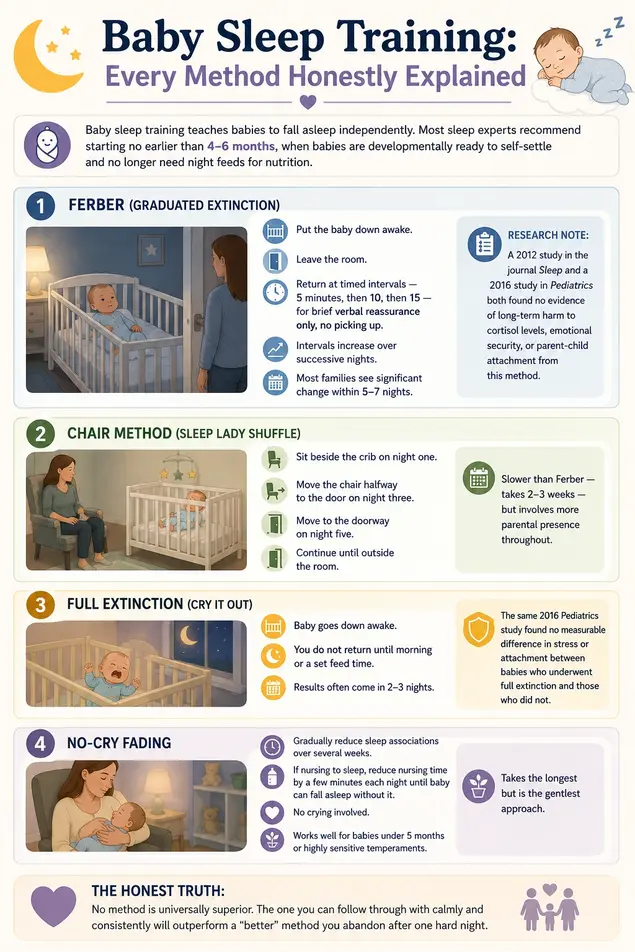
Method 1 — Ferber (Graduated Extinction) Put the baby down awake. Leave the room. Return at timed intervals — 5 minutes, then 10, then 15 — for brief verbal reassurance only, no picking up. Intervals increase over successive nights. Most families see significant change within 5–7 nights.
Research note: A 2012 study in the journal Sleep and a 2016 study in Pediatrics both found no evidence of long-term harm to cortisol levels, emotional security, or parent-child attachment from this method.
Method 2 — Chair Method (Sleep Lady Shuffle) Sit beside the crib on night one. Move the chair halfway to the door on night three. Move to the doorway on night five. Continue until outside the room. Slower than Ferber — takes 2–3 weeks — but involves more parental presence throughout.
Method 3 — Full Extinction (Cry It Out) Baby goes down awake. You do not return until morning or a set feed time. Results often come in 2–3 nights. The same 2016 Pediatrics study found no measurable difference in stress or attachment between babies who underwent full extinction and those who did not.
Method 4 — No-Cry Fading Gradually reduce sleep associations over several weeks. If nursing to sleep, reduce nursing time by a few minutes each night until baby can fall asleep without it. No crying involved. Works well for babies under 5 months or highly sensitive temperaments. Takes the longest but is the gentlest approach.
The honest truth: No method is universally superior. The one you can follow through with calmly and consistently will outperform a “better” method you abandon after one hard night.
Baby Sleep Regression: Why Everything Falls Apart 📉
Sleep regressions are periods when a previously good sleeper suddenly stops sleeping well. They are tied to neurological development, growth spurts, and motor skill acquisition — not to anything you did wrong.
| Age | Primary Cause | Typical Duration |
| 4 months | Permanent sleep cycle reorganization | 2–6 weeks |
| 8–10 months | Separation anxiety, crawling, pulling to stand | 2–4 weeks |
| 12 months | Walking milestone, nap transition | 2–3 weeks |
Signs a baby sleep regression is happening:
What actually moves things forward:
- Baby wakes every 1–2 hours after previously sleeping longer
- Naps shorten dramatically or are refused
- Increased clinginess and fussiness during the day
- More night feeds after previously dropping them
What actually moves things forward:
- Keep the bedtime routine identical — consistency is stabilizing during regressions
- Do not introduce new sleep associations you will need to remove later
- Add extra daytime connection: floor play, cuddles, skin contact
- Ride it out — most regressions resolve within 2–6 weeks
The 4-month regression is different from all others. It is not temporary. At 4 months, baby sleep architecture permanently shifts to cycle through light and deep sleep — the way adults do. If baby needs a sleep prop (nursing, rocking) to fall asleep initially, they will call for it at every single cycle all night. This is why building independent sleep skills matters so much around this age.
Newborn Sleep: The Honest Truth About the First 12 Week☀️
Newborns are not on a schedule. They are on a feed-sleep loop that runs around the clock — and that is exactly how it should be.
What is genuinely normal:
- Sleep in 2–4 hour chunks, day and night
- Day/night confusion for the first 2–4 weeks
- Breastfed babies feed every 1.5–2.5 hours, formula-fed every 2.5–3.5 hours
- Total sleep of 14–17 hours sounds like a lot — it arrives in small fragments
Gently encouraging day/night awareness — not a schedule, just awareness:
- Daytime: natural light on, normal household sounds, interaction during feeds
- Nighttime: lights very dim, quiet voice, minimal eye contact, fast changes
- Frequent daytime feeds encourage a longer nighttime stretch gradually
Do not attempt baby sleep training before 4 months. Newborns require night feeds for growth. Their stomachs are small — a breastfed newborn stomach holds only about 1–2 oz in week one. Responding at night is not creating bad habits. It is appropriate, necessary care.
Baby Sleep Environment: The Complete Setup Checklist 🛡️
| Item | Specification | Why It Matters |
| Blackout curtains | Full blackout, no light gaps | Darkness triggers melatonin; even small light leaks disrupt naps |
| White noise machine | 65 dB, placed 7+ feet from baby | Masks household noise; mimics womb environment |
| Room thermometer | Standalone digital thermometer | Do not guess — 68–72°F / 20–22°C is the target |
| Sleep sack TOG rating | 0.5 TOG: above 75°F / 24°C | Correct warmth without overheating risk |
| 1.0 TOG: 69–74°F / 21–23°C | ||
| 2.5 TOG: below 68°F / 20°C | ||
| Crib mattress | Firm, flat, no memory foam | Soft surfaces increase suffocation risk |
| Fitted sheet | One only, tight fit | No loose fabric in sleep space |
Screen-free window:
Remove all screens and bright lights from the room at least 30–60 minutes before bedtime. Blue light delays melatonin production in infants just as it does in adults.
Conclusion:
Baby sleep does not fix itself overnight. It shifts every few weeks, hits walls called regressions, and asks you to adjust as your baby grows.
But here is what stays constant through all of it: safe baby sleep rules every single time, wake windows as your daily compass, a consistent routine as your foundation, and patience as your most important tool.
The nights feel endless when you are inside them. They are not. Most babies are sleeping in longer stretches by 6–9 months — and the habits you build now are what makes that happen.
You are not failing because your baby wakes up at night. Nighttime parenting is real parenting. And the fact that you are reading this — at whatever hour it is — is exactly what a good mother does.
Disclaimer:
This article is for informational purposes only and does not replace advice from your baby’s pediatrician. All safe sleep guidelines referenced are directly from the American Academy of Pediatrics (AAP) 2024 official update. If your baby has breathing irregularities during sleep or any health concern, contact a medical professional immediately.
Frequently Ask Questions
When do babies start sleeping through the night?
Most babies become developmentally capable of a longer sleep stretch — around 5–6 hours — between 4 and 6 months. Sleeping consistently through the night, defined as a 6–8 hour stretch, often happens between 6 and 9 months. Breastfed babies typically wake more often because breast milk digests faster than formula. Night waking is biologically normal through the first year and is not caused by poor parenting.
Is cry it out safe for babies?
Yes, when used after 6 months. A 2016 study published in the journal Pediatrics followed babies through extinction-based sleep training and found no difference in cortisol levels, emotional development, or parent-child attachment compared to babies who were not sleep trained. Sleep training is a personal family choice — not a medical requirement. Many families reach the same outcome through gentler methods.
What causes the 4-month sleep regression?
At around 4 months, a baby’s brain permanently reorganizes sleep cycles to move through light and deep stages — similar to adult sleep. Babies now rouse more fully between cycles. If they relied on a sleep association to fall asleep — nursing, rocking, being held — they will call for it at every cycle through the night. The regression lasts 2–6 weeks, but the changed sleep structure is permanent.
How do I get my newborn to sleep at night?
Newborns cannot distinguish day from night until around 8–12 weeks, when their circadian rhythm begins developing through light exposure. To encourage it: keep daytime bright and stimulating, keep nighttime dim and quiet. Swaddling reduces the startle reflex and supports longer sleep stretches. Day/night awareness typically settles naturally between 8 and 12 weeks with consistent light and dark cues.
What is a safe sleep environment for a baby?
According to AAP 2024 guidelines: baby sleeps alone, on their back, on a firm flat surface — crib, bassinet, or approved play yard — with no loose items in the sleep space. Room temperature between 68–72°F. A sleep sack replaces loose blankets. A pacifier is safe after breastfeeding is established and is linked to reduced SIDS risk. These rules apply for every sleep until the baby’s first birthday.